This is a piece I started months ago, and abandoned for some reason. Better late than never…
So what about thorium as part of our clean energy future? Are there any thorium reactors operating? How do they work? How do they compare to uranium-based reactors?
Well, there appear to be a lot of plans on drawing boards, for good reason, it seems. Thorium is about three times more abundant than uranium, and is potentially a safer source of nuclear energy, which, ironically, is largely why it was overlooked early on, due to uranium’s far greater weapons potential. To quote Wikipedia,
The Thorium Energy Alliance estimates “there is enough thorium in the United States alone to power the country at its current energy level for over 1,000 years.”
When used in a liquid fluoride thorium reactor (LFTR), a type of molten salt reactor (MSR), far less nuclear waste results. And there are many other positives. An estimate by Nobel Prize-winning physicist Carlo Rubbia, for example, that a ton of thorium can produce the energy of 200 tons of uranium and three and a half million tons of coal.
And there’s more stuff about thorium’s advantages that sound just too good to be true. Wikipedia lists nine positives in bullet points. However, there are substantial start-up costs, and there are problems with ‘breeder reactors’ and proliferation, which I’ll try to understand later.
Reading the story of uranium v thorium from the late forties into the seventies, you can clearly see that the military side of the military-industrial complex, especially in the USA, won out at the expense of safe commercial and domestic energy use. But what with the recent urgency about alternatives to fossil fuels, and the concern (methinks largely unwarranted) about uranium-based nuclear, thorium is inching its way back into favour. Sabine Hossenfelder reports on its soon-to-be-arrival in Europe while castigating the German state’s pulling the plug on nuclear in general (Steve Novella of the Skeptics’ Guide is also bemused). I reckon they’re gonna change their changed mind eventually.
Anyway, the news is that the Netherlands and France, two countries that embrace nuclear power, have teamed up to bring small thorium reactors to Europe. NAAREA, a French alternative energy company, and Thorizon of the Netherlands, have combined their smarts and funds, and I’ll quote Sabine:
NAAREA is already working on small nuclear reactors, and they want to combine their technology with the thorium cores from the Dutch.
This is the concept of small, transportable nuclear reactors that I first read about in Steven Pinker’s Enlightenment Now some years ago. The fact is, though, that progress seems to be slow in this field, in spite of all the global warming concerns. NIMBYism is still a problem, as well as whole of government negativity, as in Germany. Nations that are more keen are India, which has the world’s largest thorium reserves, China, Canada and the USA.
So what about here in Australia? We have actually banned nuclear energy, both federally and in every state and territory, and there appears to be no appetite for changing the situation. This also means there’s no avenue for those interested in nuclear energy and its engineering and technical requirements to gain expertise in the field here. I suspect the only factor that will change our governmental (and popular) mindset will be the proven success of new thorium-based reactors elsewhere. Of course, Australia has the perfect climate for solar and storage, so that’s where we’re focussed, essentially. But let’s keep our minds open.
Returning to nuclear fusion, I’m focussing here on the recent Royal Institute lecture mentioned in my previous fusion post (all links below). Dr Melanie Windridge starts off with the well-known point that we’re currently failing to reach projected targets for the reduction of global warming, with current national pledges taking us to 2.4 degrees C by century’s end (the target, remember, is/was 1.5°C), with energy demand rising, and energy security issues due to political instability, among other problems.
Windridge’s pitch is that, yes, we must keep on with all the possible green solutions, but fusion is the transformational solution the world needs. It potentially produces no CO2, an abundant supply of fuel, in a safe, controlled process with no long-term radioactive waste. It would also potentially produce firm, non-intermittent, base-load power – less redundancy in the grid (I probably need to do a whole post on this) – which would be more economical in the long term. Also, decarbonisation is about much more than electricity, which apparently is only about 20% of the electricity market. The other 80% is much harder to decarbonise. Windridge lists some of them – industrial heat, aviation and shipping fuels, and desalination – which I hope to explore further in another post. There’s also the opportunity, if we could develop an effective fusion energy system, with limitless clean energy, of undoing the damage already done. Current projections show that there will still be fossil fuel-based energy in the mix in 2050. This is a challenge for those interested in pursuing the fusion solution. ‘Fusion can address the fossil fuel gap’, one of Windridge’s graphs suggests. The aim, it seems to me, is that fusion will be ‘ready’ by mid-century, at which time it will be transformative or, as Windridge says ‘we need a solution with immense potential’. But prediction is tricky, especially about the future, and as a sixty-something optimist, I can only hope that I can live and be compos mentis enough to witness this transformation.
Frankly, it’s amazing that we can be considering this type of energy, a result of relatively recent understanding of our universe. As Windridge points out, the only other form of energy that is more energy-dense is matter-anti-matter annihilation (from the first few seconds after the ‘Big Bang’) – I can well imagine future researchers and engineers trying to create a Big Bang under controlled conditions in some hyper-complex cybernetic laboratory. I wouldn’t be surprised if an SF author has already written a story…
High energy density is doubtless the holy grail of future energy technology. Windridge gives a nice historical account of this – something that Gaia Vince’s Transcendence has helped me to focus on. The industrial revolution, which began in Britain, moved us from animal energy in joules per gramme to chemical energy in kilojoules (one thousand joules per gramme). This gave Britain a fantastic edge over the rest of the world, and was the vital element in creating the British Empire. Nuclear energy, which takes us to gigajoules (billions of joules) per gramme, and which, thankfully, is being pursued internationally, and hopefully collaboratively, is a breakthrough, if it works out, comparable to the invention of fire. One kg of fusion fuel can provide as much energy as 10 million kg of coal, so it would make sense to concentrate much of our collective ingenuity on this zero-carbon form of fuel.
There are different pathways. Aneutronic fusion, as the name suggests, doesn’t rely so much on neutron energy, with its associated ionising radiation. Alpha particles or protons carry the energy. An Australian company, HB11 Energy, is using lasers to drive a low-temperature proton-boron fusion system, which is showing some promise, and deuterium-helium-3 is another combination, but currently deuterium and tritium is the easiest reaction to obtain results from. Now, considering the power of the sun, which is so energetic that, according to BBC Science Focus, ‘the Earth would become uninhabitable if its average distance from the Sun was reduced by as little as 1.5 million km – which is only about four times the Moon’s distance from Earth’, it should be pretty clear that recreating that kind of energy here on Earth’s surface is fraught with problems. The fusion ‘triple product’ for producing this energy is apparently heat, density and time. So to achieve the product in a ‘short’ time, for example, we need to tighten the other parameters – more heat and density. Safely producing temperatures much higher than those in the sun for any extended period would presumably be quite a feat of engineering. The different designs and approaches currently include tokamaks, stellarators, inertial confinement (using lasers) and magneto-inertial fusion. The inertial confinement laser model focuses lasers on a small fuel pellet, causing it to implode and produce ‘fusion conditions’.
It’s all about producing plasma of course – the so-called fourth and most energetic state of matter. Electrically-charged particles which make up over 99% of the visible universe. These charged particles spin around magnetic field lines, so allowing us to use magnetic systems to control the material. We’ve used plasma in neon lights for over a century, and its production was first demonstrated by Humphrey Davy in the early 1900s – something to explore…. Plasma is also a feature of lightning, a ‘bolt’ of which can strip electrons from the immediately surrounding air. This means that air is ionised and can be manipulated magnetically. Tokamaks and other magnetic devices operate on this principle.
Inertial confinement uses shock waves or lasers to ‘squeeze’ energy out of a pellet of fusion fuel. The point at which such energy is produced is called ignition. Think of a bicycle tyre heating up as you pump it up to a higher pressure, until the tyre explodes – sort of.
So – and I’m heavily relying on the Windridge public lecture here – fusion research really began in the fifties, generally in universities and public labs. This early work has culminated in two major public projects, ITER (the International Thermonuclear Experimental Reactor), with its ultra-massive tokamak located in the south of France, and NIF, the National Ignition Facility, located in California. which made headlines last December for ‘the first instance of scientific breakeven controlled fusion’. This involved bombardment of a pellet ‘smaller than a peppercorn’ to produce a non-negligable energy output for a very brief period.
All of this has been at great public expense (why weren’t we told?), so in more recent times, private investment is moving things along. The last couple of years has seen quite a bit of progress, in both public and private facilities. For example, JET, in Oxfordshire, produced 59 megajoules (59,000,000 joules) of fusion energy, sustained for 5 seconds, a world record and a proof of concept for more sustainable energy production. And at NIF last year they produced ‘ignition’, the whole point of the facility, producing more fusion energy than the laser energy used to drive the process, a proof of concept for controlled fusion. And even more recently, China set a new record at their EAST tokamak (don’t you just love these territorial names), attaining steady-state ‘high performance’ plasma for about 6.5 minutes (I don’t know what high performance plasma is, but I can perhaps guess). And there is a lot of work going on in the private space too (I’ll be looking at Sabine Hossenfelder’s appraisal of the field in a future post, all in the name of education), with a really notable increase in private investment and start-ups – about half of the world’s private fusion companies today are less than 5 years old. Some $5 billion has been invested, from energy companies like Shell and Chevron, but also a variety of other organisations familiar to capitalists like me.
Why is this happening? Clearly we have a greater consensus about global warming than existed a decade ago. Also the science of fusion has reached a stage where rich people and organisations are sensing the opportunity to make even more money. Windridge also talks about ‘enabling technologies’, recent engineering and technological developments such as high-temperature superconductors, diode pumps for lasers, and various AI breakthroughs and improvements. Mastering and streamlining these developments will ultimately reduce costs, as well as expanding the range of the possible. National governments are developing regulatory frameworks and ‘fusion strategies’ – the latest coming from Japan – often involving public-private partnerships, such as the UK’s Fusion Industry Programme. The UK has also created a facility called STEP – the Spherical Tokamak for Energy Production – run by the Atomic Energy Authority, which is described by Windridge as the world’s first pilot nuclear energy plant.
So in the next post on this topic I’ll be trying to get my head around the developments mentioned above, FWIW. And it is definitely worth something. If we can get it all right.
I’ve been neglecting this blog for too long, in favour of my other one, but, as a person much addicted to reading, I’ve been impressed by a writer who’s been eloquently cataloguing global problems and solutions in the Anthropocene. Gaia Vince (I presume her parents were Lovelock fans) has written 3 books, Adventures in the Anthropocene, Transcendence and Nomad century, the first two of which I now possess, the first of which I’ve read, the second of which I’m well into, and the third of which I intend to buy. So, time to return to my own self-education notes on solutions…
Vince appears to be my opposite – adventurous, extrovert, successful, in demand, and doubtless eloquent in person as well as in print. Bitch! Sorry, lost it there for a mo. The heroes and heroines of her first book, the product of travels though Asia, South America, Africa and the WEIRD world, and the solutions they’ve created and pursued, will, I think, provide me with pabulum for many blog pieces as I sit, impoverished (but not by global standards), uneducated (in a formal sense) and unlamented in rented digs in attractive and out-of- the-way, Adelaide, Australia, once touted as the ‘Athens of the South’ (at least by Adelaideans).
What I’ve found in my research on solutions – and Vince’s explorations have generally borne this out – is that solutions to global or local problems have created more problems which have led to more solutions in a perhaps virtuous circle that’s a testament to human ingenuity. And the fact that we’re now 8 billion, with a rising population but a gradually slowing rate of rising (in spite of Elon Musk), shows that we’re successful and trying to deal with our success…
So what are our Anthropocene problems? Global warming, of course. Destruction of other-species habitats on land and sea. Damming of rivers – advantaging some groups and even nations over others. Rapid industrial change (I’ve worked – mostly briefly! – in a half-dozen factories, all of which no longer exist). Population growth – in the 20th century from less than 2 billion to over 6 billion, and over 8 billion by May 2023. Toxic waste, plastic, throwaway societies, social media addiction and polarisation, the ever-looming threat of nuclear warfare… and that’s enough for now.
But on a more personal level, there’s the problem of how to navigate the WEIRD world, a world that bases itself on individualism, that’s to say individual freedom, when you don’t believe in free will (or rather, when you’re certain that free will is bullshit). And yet… a lot of smart, productive people don’t believe in free will (Sam Harris, Robert Sapolsky, Sabine Hossenfelder), and it doesn’t seem to affect their activities and explorations one bit – and to be honest it doesn’t affect my work, such as it is, either, though it does provide me with a handy excuse for my failings. My introversion has been ingrained from earliest childhood (see the Dunedin study on personality types and their stability throughout life), my lack of academic success has been largely due to my toxic family background, bullying at school, and lack of mentoring during the crucial learning period (from 5 to 65?), and my lifelong poverty (within the context of a highly affluent society) is not entirely due to laziness, but more to do with extreme anti-authoritarianism (hatred of ‘working for the man’) and a host of other issues for which I blame my parents, my social milieu, my genes and many other determining factors which I’m determined not to think about right now.
Anyway, with no free will we humans have managed transformational things vis-à-vis the biosphere, and there will be more to come. In her epilogue to Adventures in the Anthropocene, Vince hazards some predictions, using the narrative of someone looking back on the century from the year 2100, and considering the book is already about ten years old, I might use the next few posts to look at how they’re faring.
So – nuclear fusion. Here’s Vince’s take:
In 2050, the first full-scale nuclear fusion power plant opened in Germany (after successful experiments at ITER, in France, in the 2030s), and by 2065 there were thirty around the world, supplying one-third of global electricity. Now, fusion provides more than half of the world’s power, with solar making up around 40% and hydro, wind and waste (biomass) making up the rest.
So I’m starting with a very recent video by the brilliant Matt Ferrell, as a refresher for myself. Nuclear fusion, the source of the sun and stars’ energy, involves two small atoms colliding to form a larger atom (e.g. hydrogen forming helium), with some mass being converted to energy in the process. And I mean a really large amount of energy. To quote Ferrell:
Once the fusion reaction is established in a reactor like a tokamak, a fuel is required to sustain it. There’s a few different fuels that are options: deuterium, tritium or helium-3. The first two are heavy isotopes of hydrogen… most fusion research is eyeing deuterium plus tritium because of the larger potential energy output.
The power released from fusion is much greater, potentially, than that derived from fission. And deuterium plus tritium produces neutrons, which creates a process called neutron activation, which induces relatively short-lived but problematic radioactivity. And there are a host of other challenges, but it’s clear that incremental progress is happening. People may have heard of JET (the Joint European Torus) and the unfinished ITER (the International Thermonuclear Experimental Reactor), and of recent promising developments – for example, this:
A breakthrough in December 2022 resulted in an NIF [Nuclear Ignition Facility] experiment demonstrating the fundamental scientific basis for inertial confinement fusion energy for the first time. The experiment created fusion ignition when using 192 laser beams to deliver more than 2 MJ of ultraviolet energy to a deuterium-tritium fuel pellet.
Ferrell visited the Culham Science Centre, near Oxford in the UK, where he was shown through the RACE (Remote Applications in Challenging Environments) facility, a perfect acronym for the time. They’ve created a system there called MASCOT, which appears to be a cyborg sort of thing, but mostly mechanical – with a human operator. The aim is to incrementally develop complete automation for maintenance and upgrading of these highly sensitive and potentially dangerous components. Since everything is still at the experimental stage, with a lot of chopping and changing, flexible human minds are still required. Full automation is clearly the goal, once a reactor is up and running, which is still far from the case. Currently, it requires about a thousand hours of training to work with the machinery and the haptics in this pre-full automation stage, bearing in mind that the types of robotic and cable systems are still being worked out. Radiation tolerance is an important factor in terms of future developments. Culham uses a ‘life-size’ replica of a tokamak for training purposes.
RACE, as the acronym suggests, is not just a facility for nuclear research but for dealing with hazardous environments and materials in general. Moving on from JET, Ferrell visited the new MAST-U (Mega Amp Spherical Tokamak – Upgraded!). As Ferrell points out, the long lag time between promise and results in nuclear fusion has often been the butt of jokes, but this ignores many big recent developments, described well by Dr Melanie Windridge in a Royal Institute lecture, of which more later.
In the video we see a real tokamak from the sixties, probably the first ever, sitting on a table, to indicate the progress made. MAST-U’s major focus at present is plasma exhaust and its management, essential for commercial fusion power. Its new plasma exhaust system is called Super-X, a load-reducing divertor technology vis-a-vis power and heat, so increasing component lifespans. One of the scientists described the divertor as like the handle in a hot cup of coffee:
So our plasma is the coffee that we want to drink. It’s what we want, right? We want this coffee as hot as possible, but we won’t be able to handle it with our hands, we need a handle, and the diverter has the same function, it tries to separate this hot, energetic plasma from the surface of the device. So we divert the plasma into a different region, a component specifically designed to accommodate this large excess energy.
The divertor is the key factor in the upgrade and is drawing worldwide attention, as it has supposedly improved plasma heat diversion by a factor of ten, as I understand it. And MAST-U’s spherical design is potentially more efficient and cheaper than anything that has gone before. All a step or two towards more viable power plants. And, returning to JET, you can see in the video how massive the system is compared to the table-top version of the sixties. JET came into being in the 80s, and has had to deal with and adapt to many new developments, such as the H-mode or high-confinement mode, a new way of confining and stabilising plasma at higher temperatures, which has gradually become standard, requiring engineering solutions to the torus design. It’s expected that AI will play an increasing role in new incremental modifications. Simulations to test modifications can be done much more quickly, in quicker iterations, via these advances. AI, computer modelling and advances in materials science and superconductors are all quickening the process. JET will be decommissioned in about 12 months, but much is expected to be gleaned from this too, as they look at how neutrons have affected material components.
Another issue for the future is tritium, supplies of which are currently insufficient for commercial fusion production. According to ITER, current supply is estimated at 20 kilos, but tritium can be produced, or ‘bred’ within the tokamak through the interaction of escaping neutrons with lithium. Creating a successful tritium breeding system is essential due to the lack of external sources.
Okay, I’ve gone on too long here – I’ll post more of this topic soon.
the all-electric la jamais contente, first car to break the 100 kph barrier, in 1899
In his book Clearing the air, Tim Smedley reminds us of the terrible errors we made in abandoning electric vehicles in the early 20th century. Smedley’s focus was on air pollution, and how the problem was exacerbated, and in fact largely caused, by emissions from car exhausts in increasingly car-dependent cities like Beijing, Delhi, Los Angeles and London. In the process he briefly mentioned the electric tram systems that were scrapped in so many cities worldwide in favour of the infernal combustion engine. It’s a story I’ve heard before of course, but it really is worth taking a deeper dive into the mess of mistakes we made back then, and the lessons we need to learn.
A major lesson, unsurprisingly, is to be suspicious of vested interests. Today, the fossil fuel industry is still active in denying the facts about global warming and minimising the impact of air pollution on our health. Solar and wind power, and the rise of the EV industry – which, unfortunately, doesn’t exist in Australia – are still subject to ridiculous attacks by the heavily subsidised fossil fuel giants, though at least their employees don’t go around smashing wind turbines and solar panels. The website Car and Driver tells a ‘funny story’ about the very earliest days of EVs:
… Robert Davidson of Aberdeen, built a prototype electric locomotive in 1837. A bigger, better version, demonstrated in 1841, could go 1.5 miles at 4 mph towing six tons. Then it needed new batteries. This impressive performance so alarmed railway workers (who saw it as a threat to their jobs tending steam engines) that they destroyed Davidson’s devil machine, which he’d named Galvani.
If only this achievement by Davidson, before the days of rechargeable batteries, had been greeted with more excitement and wonder. But by the time rechargeable batteries were introduced in the 1860s, steam locomotives were an established and indeed revolutionary form of transport. They began to be challenged, though, in the 1880s and 90s as battery technology, and other features such as lightweight construction materials and pneumatic tyres, started to make electric transport a more promising investment. What followed, of course, with the development of and continual improvements to the internal combustion engine in the 1870s and 80s, first using gas and then petrol – the 1870s into the 90s and beyond was a period of intense innovation for vehicular transport – was a serious and nasty battle for control of the future of private road transport. Electricity wasn’t widely available in the early twentieth century, but rich industrialists were able to create a network of filling stations, which, combined with the wider availability of cheap oil, and the mass production and marketing capabilities of industrialists like Henry Ford – who had earlier considered electric vehicles the best future option – made petrol-driven vehicles the eventual winner, in the short term. Of course, little thought was given in those days to fuel emissions. A US website describes a likely turning point:
… it was Henry Ford’s mass-produced Model T that dealt a blow to the electric car. Introduced in 1908, the Model T made gasoline [petrol]-powered cars widely available and affordable. By 1912, the gasoline car cost only $650, while an electric roadster sold for $1,750. That same year, Charles Kettering introduced the electric starter, eliminating the need for the hand crank and giving rise to more gasoline-powered vehicle sales.
Electrically-powered vehicles quickly became ‘quaint’ and unfashionable, leading to to the trashing of electric trams worldwide.
The high point of the internal combustion engine may not have arrived yet, as numbers continue to climb. Some appear to be addicted to the noise they make (I hear them roaring by nearly every night!). But surely their days are numbered. What shocks me, frankly, is how slow the public is to abandon them, when the fossil fuel industry is so clearly in retreat, and when EVs are becoming so ‘cool’. Of course conservative governments spend a fortune in subsidies to the fossil fuel industry – Australia’s government provided over $10 billion in the 2020-21 financial year, and the industry in its turn has given very generously to the government (over $1.5 million in FY2020, according to the Market Forces website).
But Australia is an outlier, with one of the worst climate policies in the WEIRD world. There will be a federal election here soon, and a change of government is very much on the cards, but the current labor opposition appears afraid to unveil a climate policy before the election. The move towards electrification of vehicles in many European countries, in China and elsewhere, will eventually have a knock-on effect here, but the immediate future doesn’t look promising. EV sales have risen markedly in the past twelve months, but from a very low base, with battery and hybrids rising to 1.95% of market share – still a paltry amount (compare Norway with 54% EVs in 2020). Interestingly, Japan is another WEIRD country that is lagging behind. China continues to be the world leader in terms of sheer numbers.
The countries that will lead the field of course, will be those that invest in infrastructure for the transition. Our current government announced an infrastructure plan at the beginning of the year, but with little detail. There are issues, for example, about the type of charging infrastructure to fund, though fast-charging DC seems most likely.
In general, I’ve become pessimistic about Australians switching en masse to EVs over the next ten years or so – I’ve read too many ‘just around the corner’ articles with too little actual change in the past five years. But perhaps a new government with a solid, detailed plan will emerge in the near future, leading to a burst of new investment….
I haven’t investigated this issue before, and my general uninformed view as I begin this post is that producing fuel somehow from plants when we’re already having problems with over-use of land, and maintaining biodiversity, seems like a solution which will likely cause further problems downstream.
This general view I’ve found well expressed in an article published in The Guardian and on the World Resources Institute website in late January 2015, nearly seven years ago now. Were the authors correct then, and has anything changed since?
The 2015 article argues for solar energy as a more efficient use of sunlight, which, essentially is what bioenergy also uses. However, there are problems with getting energy generated from the sun, in, say, the Sahara Desert, to regions of high demand in Europe. And there may be ways of harnessing bioenergy without excessive land use. An article published in Nature Sustainability at the beginning of this year (2021) suggests, in its abstract, that:
growing perennial grasses on recently abandoned cropland is a near-term strategy for gradual bioenergy deployment with reduced risks for food security and the environment
The full article is behind a pay-wall, and I’m poor and cheap, but the authors appear to be arguing that a fair amount of bioenergy potential, measured in exajoules (that’s a ginormous number of joules) can be tapped from abandoned cropland, and from increasing areas of potential cropland, without affecting biodiversity or utilising essential water resources.
None of this suggests that bioenergy has major potential for an immediate future that looks increasingly dire. Saul Griffith, an Australian scientist, inventor and entrepreneur, spoke on the Climate One podcast (Electrify Everything, Oct 29 2021) about the situation.
There’ll be some geothermal; there’ll be some biofuels for some applications; there’ll be some hydroelectricity. But wind and solar are now proven to be the cheapest generators of electricity in the world.
The International Energy Agency (IEA) has an article from earlier this year about bioenergy, land, and the net-zero-emissions-by-2050 target. This is a new area for me, so I was interested in the quoted fact that, currently, some 40% of bioenergy supply (about 25 exajoules) is from solid biomass (wood, and waste materials). This is a traditional use, mostly for cooking, ‘which is inefficient, often linked to deforestation, and whose pollution was responsible for 2.5 million premature deaths in 2020’. The aim is to reduce this type of fuel to zero by 2030 – which does sound optimistic.
The plan, or hope, is to transfer to and control a sustainable bioenergy supply as part of a transformed energy economy. This energy, IEA reckons, will be divided into solid bioenergy, biogas, liquid biofuels and bioenergy with carbon capture and storage. We’re talking 2050 here, and the IEA article writes about it in the present tense (a bit weird – for example ‘by 2050 almost half of liquid biofuel use is for aviation’). It projects that around 5% of our energy generation will come from bio, and that it will be ‘an important source of low-emissions flexibility to complement variable generation from solar PV and wind’. It will also be used in the paper and cement industries, to meet high temperature heat requirements not easily electrified, and in the early future to 2030 it will be used to replace ‘dirty’ biomass – for example, improved stoves. The IEA also appears to be talking up carbon capture and storage (CCS, or BECCS if you unite it with bioenergy), that somewhat vague technology which has yet to prove itself. I’ll have to write about that in future, to comprehend the process and to see if any progress has been made.
The IEA projects that the 2050 bioenergy supply (that 5% of total) will amount to around 100 exajoules. In its optimistic scenario, 60% of this supply will come from ‘sustainable waste streams’ which don’t require land use, compared to 20% currently. The idea appears to be that we will have come much closer to solving the current waste problem – from plastics to clothing and various recyclables. Sorting and utilising will presumably be much more efficient, perhaps using advanced AI. There is also much talk of ‘advanced’ biofuels, presumably more efficient and energy dense.
The controversial issue of utilising food crops and land for bioenergy is addressed, with a scenario that involves increased usage up to 2030, then gradually reducing to zero by 2050. Short-rotation woody crops (which are generally more productive of bioenergy) on marginal lands will largely replace them.
This emphasis on reclaimed land for bioenergy-producing short-rotation woodland makes me wonder about something outside of the IEA’s purview – the other life that such woodland might sustain, or not, as the case may be. What sort of birdlife, for example, would be attracted to such human-designed forests? A forest without birdlife would be an empty place indeed, but how would any bird fit into this human scenario? The IEA’s narrow focus thus becomes problematic when biodiversity issues are raised, but intercommunication on these issues should allow such woodland to be sustainable from a biodiversity perspective.
Another interesting usage in this IEA projection is the term ‘advanced’ . There will be ‘advanced’ biofuels by 2050, as well as ‘advanced’ short-rotation woody crops, and other such advances. In some respects, this is a reasonable assumption, but unforeseen consequences are unseen, after all. Still, the IEA are intent on collaboration with other stakeholders, including presumably spokespeople for those without a voice, such as all non-human species. Quite a large and varied sector.
An article on ResearchGate from two years ago, ‘The Future of Bioenergy”, argues that land-intensive bioenergy may have uses in the short-term but is not a viable long-term option, due largely to the promise of other technologies. It quotes an earlier IEA study that finds that bioenergy has become an increasingly significant part of the current energy mix, a situation that’s likely to pertain for some time, but not so much for the long term. It also questions the viability of BECCS, which was promoted in an earlier IPCC paper. The problem with bioenergy, it seems, is that it may not be, and is unlikely to be, as green as its proven alternatives. There are, of course, major problems in applying green energy to aviation and to some heavy industries, and some current methods of biofuel production are hardly less harmful than those for conventional fuels. Land use is also an issue fraught with unforeseeables. But of course, researchers will continue their research, and new breakthroughs are always possible. Something to keep an eye on.
an artist’s impression of SA’s hydrogen power project
I recently received in the mail a brochure outlining SA Labor’s hydrogen energy jobs plan, ahead of the state election in March 2022. The conservatives are currently in power here. The plan involves building ‘a 200MW hydrogen fuelled power station to provide firming capacity in the South Australian Electricity Market’.
So, what does a ‘hydrogen fuelled power station’ entail, what is ‘firming capacity’ and what does 200MW mean?
A presumably USA site called energy.gov tells me this:
Hydrogen is a clean fuel that, when consumed in a fuel cell, produces only water. Hydrogen can be produced from a variety of domestic resources, such as natural gas, nuclear power, biomass, and renewable power like solar and wind. These qualities make it an attractive fuel option for transportation and electricity generation applications. It can be used in cars, in houses, for portable power, and in many more applications. Hydrogen is an energy carrier that can be used to store, move, and deliver energy produced from other sources.
This raises more questions than answers, for me. I can understand that hydrogen is a clean fuel – after all, it’s the major constituent, molecularly speaking, of water, which is pretty clean stuff. But what exactly is meant by ‘clean’ here? Do they mean ‘carbon neutral’, one of today’s buzz terms? Presumably so, and obviously hydrogen doesn’t contain carbon. Next question, what exactly is a fuel cell? Wikipedia explains:
A fuel cell is an electrochemical cell that converts the chemical energy of a fuel (often hydrogen) and an oxidizing agent (often oxygen) into electricity through a pair of redox reactions. Fuel cells are different from most batteries in requiring a continuous source of fuel and oxygen (usually from air) to sustain the chemical reaction, whereas in a battery the chemical energy usually comes from metals and their ions or oxides that are commonly already present in the battery, except in flow batteries. Fuel cells can produce electricity continuously for as long as fuel and oxygen are supplied.
So the planned 200 megawatt power station will use the chemical energy of hydrogen, and oxygen as an oxidising agent, to produce electricity through a pair of redox reactions. Paraphrasing another website, the electricity is produced by combining hydrogen and oxygen atoms. This causes a reaction across an electrochemical cell, which produces water, electricity, and some heat. The same website tells me that, as of October 2020, there were 161 fuel cells operating in the US with, in total, 250 megawatts of capacity. The planned SA power station will have 200 megawatts, so does that make it a gigantic fuel cell, or a fuel cell collective? In any case, it sounds ambitious. The process of extracting the hydrogen is called electrolysis, and the devices used are called electrolysers, which will be powered by solar energy. Excess solar will no longer need to be switched off remotely during times of low demand.
There’s no doubt that the fortunes of hydrogen as a clean fuel are on the rise. It’s also being considered more and more as a storage system to provide firming capacity – to firm up supply that intermittent power sources – solar and wind – can’t always provide. The completed facility should be able to store 3600 tonnes of hydrogen, amounting to about two months of supply. There are export opportunities too, with all this excess supply. Japan and South Korea are two likely markets.
While it may seem like all this depends on Labor winning state government, the local libs are not entirely averse to the idea. It has already installed the nation’s largest hydrogen electrolyser (small, though, at 1.25 MW) at the Tonsley technology hub, and the SA Energy Minister has been talking up the idea of a hydrogen revolution. The $11.4 million electrolyser, a kind of proof of concept, extracts hydrogen gas from water at a rate of up to 480 kgs per day.
The difference between the libs and labor it seems is really about who pays for the infrastructure. Unsurprisingly, the libs are looking to the private sector, while Labor’s plans are for a government-owned facility, with the emphasis on jobs. Their brochure on the planned power station and ancillary developments is called the ‘hydrogen jobs plan’. According to SA’s Labor leader, Peter Malinauskas, up to 300 jobs will be created in constructing the hydrogen plant, at least 10,000 jobs will be ‘unlocked from the $20bn pipeline of renewable projects in South Australia’ (presumably not all hydrogen-related, but thrown in for good measure) and 900+ jobs will be created through development of a hydrogen export industry. He’s being a tad optimistic, needless to say.
But hydrogen really is in the air these days (well, sort of, in the form of water vapour). A recent New Scientist article, ‘The hydrogen games’, reports that Japan is hoping that its coming Olympic and Paralympic Games (which others are hoping will be cancelled) will be a showcase for its plan to become a ‘hydrogen society’ over the next few decades. And this plan is definitely good news for Australia.
Japan has pledged to achieve net-zero greenhouse gas emissions by 2050. However, this is likely impossible to achieve by solar or other established renewables. There just isn’t enough available areas for large scale solar or wind, in spite of floating solar plants on its lakes and offshore wind farms in planning. This is a problem for its hydrogen plans too, as it currently needs to produce the hydrogen from natural gas. It hopes that future technology will make green hydrogen from local renewables possible, but meanwhile it’s looking to overseas imports, notably from Australia, ‘which has ample sunshine, wind and empty space that make it perfect for producing this fuel’. Unfortunately we also have an ample supply of empty heads in our federal government, which might get in the way of this plan. And the Carbon Club, as exposed by Marian Wilkinson in her book of that name, continues to be as cashed-up and almost thuggishly influential as ever here. The success of the South Australian plan, Labor or Liberal, and the growing global interest in hydrogen as an energy source – France and Germany are also spending big on hydrogen – may be what will finally weaken the grip of the fossil fuel industry on a country seen by everyone else as potentially the best-placed to take financial advantage of the green resources economy.
References
Hydrogen Jobs Plan: powering new jobs & industry (South Australian Labor brochure)
‘The hydrogen games’, New Scientist No 3336 May 2021 pp18-19
Marian Wilkinson: The Carbon Club: How a network of influential climate sceptics, politicians and business leaders fought to control Australia’s climate policy, 2020
So I’ve heard more exciting info recently from the Skeptics Guide to the Universe (SGU), this time returning me to Australia – Queensland more specifically. And some are describing this as the big battery technology breakthrough many of us have been waiting and hoping for.
So, lithium-ion batteries go back to the late sixties, though we can go back further to the twenties when it was noted that lithium’s electrochemical properties, such as low density, high specific capacity and low redox potential, would make it a likely battery anode material. I’m tempted to go into a thorough self-education investigation of how li-ion batteries were developed and how they work, but I’ll resist it and go straight to the new tech.
Graphene is an allotrope, or form, of carbon, as is diamond and various fullerenes. It consists of a single layer of atoms in a hexagonal lattice. Graphite, a very stable carbon allotrope, consists of stacked layers of graphene. The clean technology company Graphene Manufacturing Group (GMG), based in Queensland, manufactures graphene via a ‘proprietary production process’ which utilises natural gas (methane) rather than graphite. Its current principal focus, according to its website, is ‘developing applications for energy saving and energy storage solutions’. In its corporate overview, here’s what the company has to say on the battery front:
In the energy storage segment GMG and the University of Queensland are working collaboratively with financial support from the Australian Government to progress research and development, and ultimately explore the commercialization of GMG graphene aluminium-ion batteries. Aluminium-ion batteries have the potential to have better energy density than lithium-ion batteries. Graphene Aluminium-ion batteries may eliminate many disadvantages of LI Batteries, including the risk of overheating/fire and performance degradation. Management believes that successful commercialization of the Graphene Aluminium-ion batteries would result in a superior substitute to LI Batteries in targeted applications.
At this point they are promising longer battery life – up to 3 times – and very much faster charging – up to 60 times, something like a supercapacitor. There are no problems with overheating – lithium requires a cooling system, using more space and energy. They also describe the battery as ‘planet-friendly’, in that it doesn’t require scarce resources, such as lithium, which has become much more expensive recently. In fact, Australia is the world’s largest producer of bauxite ore, from which aluminium and gallium are extracted, so these batteries could put Australia in the box seat for production and manufacture. A ‘secure and simplified supply chain’ is one of the benefits touted by the company. Other benefits include safety (no catching fire), stability (no spontaneous discharge, i.e. energy leakage), and improved energy and power density. The batteries will have a longer lifespan, with many charge-discharge cycles. And at the end of the day they should be more recyclable. GMG also promises that these new batteries can be fitted within existing battery housing – no modifications required.
So how does the battery work? Here’s where I have to learn stuff. These are a class of rechargeable battery in which aluminium ions flow from the anode (the positive electrode) to the cathode and back. As to the cathode, I think that’s where graphene comes in. Based on breakthrough technology developed at the University of Queensland’s Australian Institute for Bioengineering and Nanotechnology, the battery cells ‘use nanotechnology to insert aluminium atoms inside tiny perforations in graphene planes’. Aluminium ions are trivalent, meaning they have three valent, or ‘free’, electrons to play with, compared to lithium’s one. This has had both benefits and disadvantages in the past. The three units of charge per ion means more energy density or storage capacity, but, according to Wikipedia, ‘the electrostatic intercalation of the host materials with a trivalent cation is too strong for well-defined electrochemical behaviour’. I don’t know what this means, but presumably this is the problem that the use of graphene solves.
Whether these new batteries will effectively replace li-ion batteries is a question. Established industries don’t move aside easily, and it’s likely that the new technology will be better for some applications than for others. Li-ion is not only well established, the technology is constantly improving. And nickel metal hydride, the previous form of rechargeable battery, still has its place, I believe.
Things are apparently moving fast. GMG CEO and Managing Director Craig Nicol said, “We are currently looking to bring coin cell commercial prototypes for customer testing in 6 months and a pouch pack commercial prototype – used in mobile phones, laptops etc. – for customer testing in 18 months. We are really excited about bringing this to market. We aim to have a viable graphene and coin cell battery production facility project after customer validation that we would likely build here in Australia”. According to the SGU the company expects to have EV batteries ready by 2024.
So that’s about it. But here’s some other random but relevant info:
Since 2005, lithium costs have increased nine-fold, while aluminium costs have increased by 20%.
Currently 90% of lithium is accessed from China, 10% from Chile – but I heard on Fully Charged that Australia is a major source of lithium, so I’m confused.
Basic ingredients of the new battery: ‘aluminum foil, aluminum chloride (the precursor to aluminium and it can be recycled), ionic liquid and urea’ (Craig Nicol)
From graphene-info.com: Now, GMG has shared the initial performance data when tested in coin cells for the patent-pending surface perforation of graphene in aluminium-ion batteries developed by the Company and the University of Queensland (“UQ”). Currently, GMG Graphene is producing coin cell prototypes for customer testing in Q4 2021.’
From Dr. Ashok Nanjundan, GMG’s Chief Scientific Officer: “This is a real game-changing technology which can offer a real alternative with an interchangeable battery technology for the existing lithium-ion batteries in almost every application with GMG’s Graphene and UQ’s patent-pending aluminium ion battery technology. The current nominal voltage of our batteries is 1.7 volts, and work is being carried out to increase the voltage to directly replace existing batteries and which lead to higher energy densities….. The real differentiator about these batteries is their very high power density of up to 7000 watts/kg, which endows them with a very high charge rate. Furthermore, graphene aluminium-ion batteries provide major benefits in terms of longer battery life (over 2000 charge / discharge cycles testing so far with no deterioration in performance), battery safety (very low fire potential) and lower environmental impact (more recyclable)”.
So, I’ll be following developments over the next few months and years…
solar wind and our magnetic shield-field – so much more to learn
I’m not a physicist, or anything else scientific, I’m just an ageing sponge, trying to suck up knowledge and understandings in the diminishing time I have left. Physics is just one vast web of knowledge that I’ve barely stepped upon, to mix metaphors, but that won’t stop me trying to make some sense of orbital mechanics in this post, with the help of the Skeptics’ Guide to the Universe (episode 826), and other sources.
The NASA Parker Solar Probe (PSB) is the fastest human-built object, and also holds the record for closeness to the sun. It was launched in August 2018 and weighs around 73 kgs. Named for Eugene Parker – a multi-award-winning solar astrophysicist who worked out the effects of the solar wind and predicted the spiral shape of the solar magnetic field in the outer solar system – the PSB recently (only a month ago) got to within about ten million kilometres of the sun’s service. The next closest artificial object was the Helios spacecraft, in 1976, at a distance of about 43 million kms. Mercury, which has a highly elliptical orbit, only gets as close as 47 million kms at perihelion.
The PSB is part of NASA’s Living With a Star (LWS) program, which investigates the Sun-Earth system as it affects our sun-dependent and sometimes sun-threatened lives. For example, the SGU references the Carrington Event, the largest geomagnetic storm on record, caused by a solar coronal mass ejection hitting the Earth’s magnetosphere in early September 1859. If such an event occurred today, it would cause massive damage to our electrical grid systems and satellites. So the PSB is designed to study the sun’s corona and solar wind, presumably in the hope of providing an early warning of future events. For this purpose it’s loaded with various forms of detecting and measuring instruments. However, my interest here is in trying to understand how the probe gets from Earth to the Sun’s corona, how it’s expected to reach speeds of up to 690,000 km/h, and how it can withstand the temperatures in the corona.
It has apparently been calculated that it takes 55 times the energy to get to the Sun as it takes to get to Mars. This is all about orbital mechanics – the sun is spectacularly massive, making up 99.8% of the mass of the solar system. That means it also has a spectacularly massive gravitational pull on the Earth, and all other orbiting bodies. It’s the Earth’s ‘sideways’ velocity (107,208 km/h) that keeps it from falling into the sun. So the Earth’s orbital velocity needs to be taken into account – cancelled out – in planning a trip to the Sun. It turns out that it’s inordinately difficult to do so. With current technology they have only managed to cancel out about 80% of this velocity – which will bring the PSB close to the Sun but not close enough. Travelling to the outer planets is much easier. The probe would leave Earth at 40,000 km/h (escape velocity) and would require a relatively slight boost (6-7,000 km/h) to reach Mars, and further small boosts to reach the other outer planets.
The solution to this cancellation problem is to employ an orbital manipulation called Venus Earth Gravity Assist (VEGA). The PSB was sent to Venus to reduce the sideways orbital motion. Every swing around Venus further reduces this motion, and allows the PSB to decrease the orbital perihelion ultimately to about 7 million kms, at which time it will be travelling at its maximum speed. This will occur at Christmas Eve 2024 (they can be quite precise, apparently), after the last of its planned seven swings around Venus. The probe’s orbit around the Sun will be highly elliptical, with a minimum of time spent around perihelion, to prevent radiation damage to the craft and instrumentation.
Of course the PSB will also come equipped with probably the most sophisticated heat shield or thermal protection system ever built, which will protect it not only from the intense heat and radiation but from high-velocity dust particles. It measures about 2.5 metres in diameter and is made from carbon foam between layers of superheated carbon-carbon composite, aka reinforced carbon-carbon (carbon fibre in a matrix of graphite). Its outer aluminium oxide coating is, naturally, reflective white, to protect probe and equipment from a maximum temperature at perihelion of about 1370 degrees celsius. NASA expects that the inner side of the shield will be at a little under 30 degrees – so cool in fact that some instruments will be independently heated to operate at maximum efficiency. The probe has been created to be as autonomous as possible, given its distance from Earth. For example, if instrumentation somehow becomes exposed to radiation, four light sensors will ‘detect the first traces of direct sunlight coming from the shield limits and [engage] movements from reaction wheels to reposition the spacecraft within the shadow again’, to quote the Wikipedia article on the probe.
This solar probe concept was first mooted in the late 1950s but was regularly postponed due to costs. The initial idea was for a less direct route using a gravity assist from Jupiter, which would have created a longer and more expensive mission and would have required a nuclear battery called a radioisotope thermal generator. Something to research in another post maybe.
So I won’t pretend that I understand all the mathematics of this probe’s voyage, but I do know that it has been successful so far, at least in terms of its travel – the Venus assists and the solar orbits, which will all come to an end on August 29 2025. As to whether it will be successful in its research tasks, that will have to be evaluated over time. What precisely are those research tasks? There are three main ones: to trace the flow of energy that heats the corona and accelerates the solar wind, to determine the structure and dynamics of the magnetic fields that create the solar wind, and to determine what mechanisms accelerate and transport energetic particles.
Whether the knowledge gained will protect us from future solar wind and electromagnetic activity nobody knows. Predictions about the future are probably the most uncertain predictions of all.
Thinking of solutions often makes me think of water. I’m fascinated by water’s multiple uses in our world. As a cleaning agent, for example. What does it mean, that water cleans things? Well, take the case of dirty dishes. You’ve got some dinner dishes, with small scraps of meat, vegetables, some sauce, some cake crumbs, etc. They’ve been left on the sideboard for a few hours, so that the food scraps have dried out and are stuck to the dishes. Put these few plates, bowls, forks, knives and spoons in a basin of warm water for, say, twenty minutes. You will find that, with a minimal quantity of cleaning agents added – soap is perfectly adequate – you’ll be able to remove all the crumbs and bits of sauce from the plates and utensils easily with your hands. I find hands really great for cleaning, you can feel every lump and bump.
So what’s happening here? Certain chemical processes have occurred. First, The material on the crockery has dried out, over a period of hours. That means it has lost water to the surrounding air. Evaporation of water can occur at any temperature, as the surface water molecules have a higher kinetic energy, explained apparently by the Maxwell-Boltzmann distribution, which I won’t go into here.
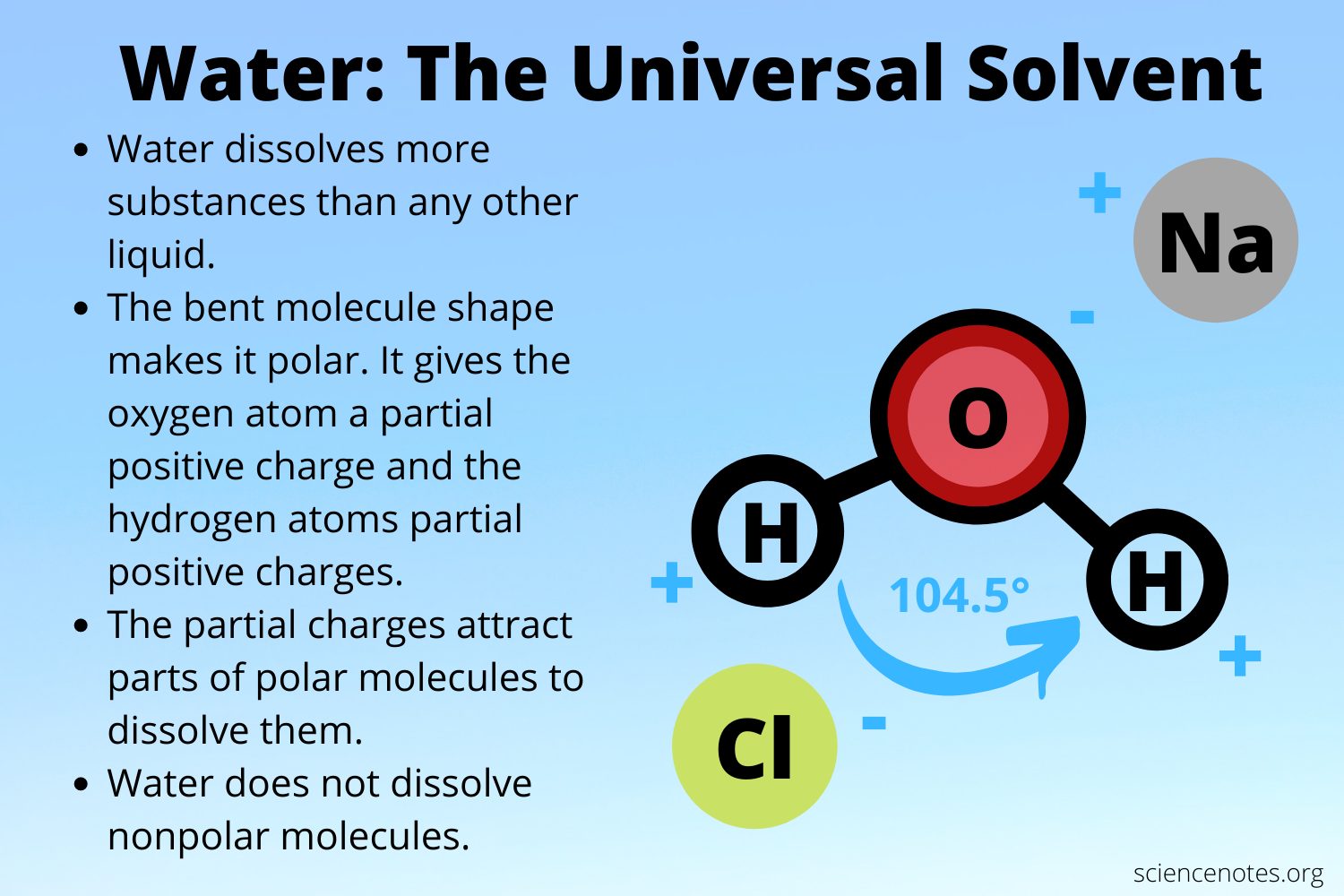
So when the dirty dishes are placed in water, reactions occur. Stuff dissolves in water. This is because H₂O is a polar molecule – its oxygen head is electronegative and its two hydrogen tails are electropositive. That’s because the oxygen pulls the electrons it shares with the hydrogen – called covalent bonding – closer to itself, giving it a slightly negative charge, and the hydrogens a slightly positive charge. This polarity attracts water molecules to each other. So if there are any water molecules left on the dirty dishes, and there will be, the basin water will be attracted to them, so softening and breaking up the food particles. And if there is salt in the sauce and sugar in the cake, these will dissolve in the water, because the polar bonds in H₂O are stronger than the ionic bonds in salt (NaCl), so breaking them down, and H₂O will connect with the polar O-H bonds in sucrose (C12H22O11).
I’ve mentioned two other useful factors for cleaning – heat and soap. Any unfortunate who sugars their coffee will know how effective heat is for dissolving their poison. This is simply to do with the energy state of the water molecules. The excited molecules interact more rapidly with the sugar, or salt, causing their rapid dissolution. Soap, and other detergents, act as cleansing agents for a very different reason.
Some substances, particularly hydrocarbons, such as hexane (C₆H₁₄), found in petrol and many glues, are insoluble in water. In our example, think of cooking oil and fats. Greasy stuff. Soap is made up of molecules called surfactants. These lengthy molecules have a water-loving (hydrophilic) head and a grease-loving (hydrophobic) tail, so to speak. Here’s a neat summary of what happens, from Science on the shelves, a website of the University of York:
The head of the molecule is attracted to water (hydrophilic) and the tail is attracted to grease and dirt (hydrophobic). When the detergent molecules meet grease on clothes [or dishes], the tails are drawn into the grease but the heads still sit in the water. The attractive forces between the head groups and the water are so strong that the grease is lifted away from the surface. The blob of grease is now completely surrounded by detergent molecules and is broken into smaller pieces which are washed away by the water.
More detail can be gone into here, but this is a start. The fact that water is such an effective solvent has so many implications for all living organisms it’s hard to know what to turn to next, so I’ll have to give it a think.
I should point out that in researching this piece, which certainly wasn’t hard work, I found at least a dozen good videos describing water as a solvent, and there were countless other videos describing other properties of water. I’m very grateful to be living in the internet age, when so much of this thought-provoking material is so readily available.
We’re literally the first generation that can actually do democracy because it was illegal in our parents’ age. Because of that, there’s a lot more room to innovate.
Audrey Tang, Taiwan’s Digital Minister
inside Taiwan’s Social Innovation Lab
Taiwan is a nation with a complex recent history and an uncertain future, faced as it is with an aggressive and extremely powerful neighbour which utterly rejects its claim to independence. But while this future largely depends on the winds, or whims, of international support for its fledgling democracy, it is making progress on its own with new approaches to participatory decision-making, using crowd-sourcing and other digital methods.
These new approaches had their foundation in 2014, when a mass protest movement, called the Sunflower Movement, sprang up in opposition to an attempt by then President Ma Ying-jeou, of the governing Kuomintang, to create a trade deal with China, called the Cross-Strait Service Trade Agreement (CSSTA) – clearly a highly sensitive issue, especially for Taiwan’s youth. The demonstrations – effectively opposing the one China policy in general – were massive, involving half a million people out of a population almost equal to that of Australia, but they were also ‘smart’, as they involved the use of smart phones to communicate and organise effectively.
The success of the Sunflower Movement led eventually to a change of government – the Kuomintang, which had democratised since the 1990s but which had long been tainted with neofascism, was finally ousted in 2016, and a centre-left government, the Democratic People’s Party (DPP), was installed, and returned with an increased majority in 2020. But a perhaps a more interesting outcome of the movement was the development of online participatory democracy platforms such as vTaiwan. The DPP has embraced digital technology to the point of creating a Digital Minister, Audrey Tang, a heroine to a diversity of communities.
Participatory or open democracy is an attempt to flatten hierarchies by creating online spaces for citizen deliberation and more open access to elected representatives. The emphasis is on diversity, and ‘forking the government’, a joke term of sorts, which Jess Scully explains:
In programming, forking means creating alternative approaches to a subset of a program (that is, writing some new code) and testing those in parallel with the status quo. Once the alternative code is working well, it’s merged into the system permanently.
J Scully, Glimpses of utopia, p 60
As Tang explains, forking, in the strictly digital sense, has become a more flexible process in recent years, and this can be seen as a metaphor for governance. She sees her department as horizontal, and set within a broader government system that is as horizontally organised as practicable. Other terms such as sandboxing, are taken from the new tech world to describe experimental processes contained in lower-risk spaces such as the nation’s Social Innovation Lab before unleashing them on an unsuspecting public. These processes encourage the testing and tweaking of a diversity of inputs and responses to proposals from within or outside government, and clearly vTaiwan, the online platform, plays a key role. Government bureaucrats are encouraged to be proactive in formulating ideas and expected to be accountable in providing feedback to others. Accountability and reward go together.
It all sounds very idealistic, and there have certainly been roadblocks – such as getting government reps to take the issues discussed seriously – but vTaiwan and other such open-source platforms have allowed dissenters to articulate their grievances, and more importantly, to suggest solutions. Demonstrations can give way to consultations and collaboration. One key innovation in this consultative process is that no comments are permitted on proposals, thus eliminating divisiveness and trolling. Instead, proposals are upvoted or downvoted, so that maps of consensus can quickly emerge. Also, some proposals garner more attention for or against than others and so can be seen as focusing on issues of greatest public concern.
An even more successful platform, endorsed and utilised by Tang, is Join, created by the National Development Council, another government initiative. Often debate and contributions on these platforms lead to a complete reformulation of the original issue with innovative and wide-ranging solutions.
Taiwan’s outstanding performance in combatting Covid-19 has naturally made the country a focus of international interest. In an article written last December, ‘Digital participation in Taiwan: takeaways for Europe’, Dominik Hierlemann and Stefan Roch described the country’s success:
Taiwan’s open and vibrant social media called the “PTT bulletin board” was able to pick up the news and evidence of a new and dangerous virus in Wuhan as early as December 2019 and directed the information effectively to Taiwan’s Centre for Disease Control. Based on that information, the centre started to check all incoming flights from Wuhan and created a collective information system for all citizens, as well as with the help of citizens. As Taiwan immediately started rationing masks, an interactive App was quickly developed that helps people track down pharmacies that have masks on stock, so that the entire population could be effectively supplied. To this day, the Centre of Disease Control holds daily public briefings based on information collaboratively collected by itself, experts and citizens.
As Audrey Tang points out, Taiwan has more social media accounts than it has citizens, and it treats cheap broadband access as essentially a human right. With encouragement from one of the world’s most tech-savvy governments, the population is digitally interconnected like no other. And the Social Innovation Lab, based in Taipei, has a drop-in centre, open 16 hours a day, for people to meet, talk and eat in a relaxed atmosphere, exchanging ideas and plans informally and face-to-face. It all seems to be working, and more and more people worldwide are taking an interest.



 solution