Author Archives: stewart henderson

Unknown's avatar

About stewart henderson

Stewart, aka Luigi Funesti Sordido of the USSR, the Urbane Society for Sceptical Romantics. A dilettante, basically.

What is the future for renewable energy in Australia?

coffs-coast-climate_action-group-copyright-seenaustralia-001a-mv5y0v4cay562s49wi2_t460

It’s the energy of the future, according to its promoters. I’m talking about solar, wind and other sources of renewable energy. It seems, though, that due to ‘institutional dysfunction’, as one pundit describes it, renewable energy is facing a bleak future in Australia, at least in the short term.

Recently a review of the nation’s renewable energy target (RET), by a panel chosen by the Prime Minister’s office, has recommended substantially reducing the target. The panel was headed by a former chairman of Caltex Oil, Dick Warburton, who is unconvinced that increased carbon dioxide causes global warming. He’s wrong about that.

The RET is currently set at 41,000 gigawatts an hour of renewable energy by 2020, and it apparently represents a threat to the traditional energy companies at a time when electricity consumption is falling. As Ross Gittins points out in The Sydney Morning Herald, the fall in consumption over the last four years is unprecedented and has taken the industry completely by surprise.

So why has consumption fallen? According to an Australia Institute report by Dr Hugh Saddler, the decline has been entirely at the expense of coal-fired generators, many of which are struggling to be profitable. The main cause is simply an increase in energy-efficient buildings and appliances, due to regulations brought in in the late 90s. Other factors, in order of significance, include the economic shift from electricity-driven industry (with major steelworks, aluminium smelters and oil refineries, either shutting down or cutting back), the failure of many other electricity-guzzling industries to grow as expected, and, since 2010, consumer response to higher electricity prices and the carbon tax (either the real one or the slightly scarier one concocted by the conservatives in opposition). The price hikes, ironically, were largely a result of expenditure on upgraded poles and wires to meet expected new peaks in summer demand. The decreased residential usage provided intriguing proof that we can, if needs must, wean ourselves from ever-spiralling consumption. Meanwhile the increased capacity, for which consumers will continue to pay into the future, remains unused.

So what has this to do with renewable energy, and why does the Prime Minister’s panel recommend downgrading the RET? According to Peter Martin, the economics editor of The Age, it’s because the renewable energy sector has gotten too big for its boots and is significantly cutting into the profits of the fossil fuel industries. However, the repealing of the carbon tax was a big win for those industries, and the abandoning of the old RET, assuming the panel’s recommendations will be acted upon, will be another boost.

It looks like the federal government, probably under pressure from the fossil fuel lobby, is set to reduce or abandon the RET. The Warburton panel was set up in February by a Prime Minister who has stated at a public meeting that anthropogenic global warming is ‘bullshit’ (though he has tried to backpedal furiously from this since). The conservatives have chosen to ignore a review of the RET by the Climate Change Authority, released in December 2012. The Climate Change Authority was set up under the Gillard labor government in July 2012 to conduct climate change research and to regularly review associated policies, but the conservatives are trying to scrap it, though their first attempt was blocked in the Senate in March of this year, and the Authority now appears to be in limbo. It’s difficult not to conclude that the Warburton panel, which includes other industry heavyweights, has been set up to deliver the government what it wants.

So, bearing in mind the guidelines to problems and solutions I’ve taken from David Waltner-Toews, what exactly are the problems here, and how can we move towards solutions?

Not surprisingly, there’s more than one problem. For example, one problem is with the Warburton panel itself. The strong perception within the renewable energy sector and its potential investors is that the panel’s findings are already known, and that RET targets will be reduced or abandoned, leading to job losses and a substantial loss in investor confidence. In fact investors are already backing out because of the new climate of uncertainty.

Of course the panel isn’t bent on destruction. It presumably sees the problem elsewhere – a substantial decrease, at least domestically, in fossil fuel consumption. But why would anyone want to preserve a highly polluting industry when there are clean alternatives available? Well I can think of two reasons, apart from the obvious vested interests. First, job losses. The Greens and other clean energy advocates are heavily emphasising the job and investment losses in that market if the RET were to be abandoned, but of course the fall in consumption together with the challenge of the new technologies were leading to the same problems on the other side, and of course losses on one side can’t be simplistically balanced by gains on the other, and I’ve no idea how the actual numbers would fall out. Second, these industries aren’t simply limited to the domestic market. In fact the industry has long been heavily subsidised by the federal government because its exports are a major contributor to government revenues and to foreign exchange earnings. The government protection of the industry has of course been strongly criticised by the renewable energy sector, which is keen to point out that Australia is the highest per capita emitter of greenhouse gases in the world, with the fossil fuel industry playing the primary role in maintaining that record. But it’s difficult, especially for a conservative government with little obvious concern for the greenhouse issue, to see beyond the substantial revenues that coal and natural gas are bringing in.

Before we start talking solutions, we need to squarely face the evidence. Anthropogenic global warming is happening, and climate scientists are only in disagreement about rates and precise consequences in what is an enormously complex climate system. As just mentioned, Australians  have the worst per capita record in the world in contributing to the problem, and our coal industry produces about 38% of our total greenhouse gas emissions.

The aim should be to reduce our emissions while still providing all the energy required to maintain our lifestyles – though all the while being mindful that some tweaking of those lifestyles might substantially reduce emissions. We need to win the battle with government, as to the value and the necessity of emissions reduction, but we also need to be realistic. How much of our energy needs can be met by renewables, now and in the near future? Is it worth trying to clean up the fossil fuel industry? Is clean coal a possibility, or a myth?

On this latter issue, a US organisation, the Union of Concerned Scientists, has this to say:

Technology is evolving that has the potential to substantially reduce coal’s contribution to global warming by capturing carbon emissions before they are emitted. This technology could become an important part of the battle against global warming, but it remains to be seen whether it will work at a commercial scale and at what cost.

So here’s one weighty problem. We’re still heavily reliant on fossil fuels, though that reliance is reducing, as well as our overall energy usage. Reduced energy usage is seen as a problem rather than a victory, which may be a perception problem rather than a real problem, but it is a real problem insofar as the fossil fuel industry is losing revenue locally, which is affecting its ability to be competitive in the overseas market. Around 70% of Australia’s coal production is sent overseas, making Australia proportionally the world’s largest coal exporter. Coal is our second biggest export earner, worth more than $40 billion per annum.

Another problem is that we’re paying, into the future, for the new infrastructure above-mentioned. Arguably, we’re paying for the lack of foresight of the fossil fuel industry, which is passing on to the consumer the costs of an unnecessary extra capacity. Presumably if more consumers switch to solar for their domestic energy supply, this infrastructure cost burden will be shared among fewer people.

Also, those that want to reduce Australia’s carbon emissions through reduction of our fossil fuel production and exports have to counter the argument that our exports represent some 5% of global coal consumption, while the economic cost to us of cutting exports would be very substantial. It’s the ‘great pain for little gain’ argument.

There’s also another good point made by Chris Greig, Professor of Energy Strategy at the University of Queensland. We make the mistake, living as we do in an energy-rich nation, of assuming that our supply of coal is simply adding to the abundance, with disastrous consequences, but there are many parts of the world that are energy-poor, and would be deprived of opportunities to rise from poverty if the fuel supply from nations such as ours were to be cut off. By all means we should try to improve the efficiency of the fuel we export, and we should be looking to renewable alternatives in these energy-deprived regions, but some renewables are not suitable for some regions, and most cannot deliver base-load power as they currently stand. There are no easy solutions to this problem. Curently – and this returns me to my previous post – there’s a huge problem of indoor pollution in developing countries due to the lack of a clean, or cleaner, energy supply. Professor Greig effectively summarises the issue:

Few Australians realise that two million people in developing countries die each year due to indoor air pollution from biomass combustion – typically a black smoke containing fine particulates, carbon monoxide and nitrogen oxides. The indirect consequences are also far-reaching. The relentless harvesting of biomass wood for fuel is responsible for depleting groundwater systems and declining agricultural productivity, which in turn leads to food and water shortages and reinforces the poverty cycle. And let’s not forget the one billion tonnes of CO2 that are released annually as a result of this rudimentary burning of biomass materials.

All of this is further evidence of the complexity and messiness of the issues involved. Clearly they won’t be fully covered in this post, and I’ll be returning to the subject in the future, to look at nuclear power among other things. I’ve also got Naomi Klein’s monumental opus, This changes everything, a tale of climate change and capitalism, to plough through.

Meanwhile, the Australian situation with regard to renewables is still very much up in the air, with Federal Environment Minister now making assurances that the RET will not be scrapped, while not ruling out a downgrading. Climate Change Authority head Bernie Fraser, along with Business SA, suggest retaining the 41,000GWh target but extending the time-frame beyond 2020. This might help to maintain business investment while taking a little pressure off the fossil fuel industry, which might take the opportunity to review and improve future planning, with perhaps a greater focus on exports.

Whatever the future for all these businesses and technologies, the aim of a more sustainable, less carbon-intensive and less polluting energy supply should be paramount. If that means job losses as the dirtiest and least efficient power plants are closed, then that needs to be faced, unless they can be profitably cleaned up.

Having said that, Australia’s future lies in renewables, especially wind and solar. Our current government seems to be having trouble taking the long view on this, and it’s positively embarrassing to find a country that is in many areas among the most modern and technologically developed in the world falling behind so badly in a field we should be leading. I await with interest the government’s coming announcement on the RET. I’m sure they realise what’s at stake.
 

indoor pollution, and some general points about solutions

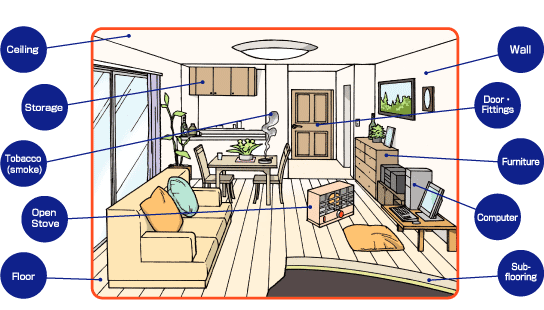
possible sources of formaldehyde in the home. But remember - be aware, not alarmed

possible sources of formaldehyde in the home. But remember – be aware, not alarmed

In a book review published, or linked to, on 3 quarks daily, Philip Hoare cited a number of gloomy facts about our impact on the biosphere. I won’t contest them, but I was struck by this one:

Only 1 per cent of the world’s urban population are breathing air clean enough to meet EU standards according to a 2007 report by the World Bank (the Chinese government, fearing social unrest, redacted it on publication).

This struck me because I’ve read elsewhere that our city air has always been polluted, but has improved in recent times, due to our greater awareness of pollution and our ability to clean up our act, to adapt. It’s difficult to get to the truth here, of course. I’d love to be able to walk down a London street in 2007, then repeat the act in 1907, 1807 and 1607, but the fact is that EU standards have only been around for the life of the EU, and standardised monitoring of cities is a comparatively recent phenomenon. The Romans used lead piping rather more often than was good for them in their cities (as many of them well knew), and investigation of the lungs of paleolithic cave dwellers have revealed smoke from home fires as the first known deadly anthropogenic pollutant.

I’ve never been to China but I do teach a lot of Chinese students, who mention often, without prompting, the pollution of their cities, so of course there are problems, though I wonder whether EU standards might be a bit tough. Be that as it may, what solutions are being implemented for cleaning up our cities?

The WHO has described air pollution as the world’s biggest environmental health risk, with 7 million deaths being sheeted home to air pollution in 2012, but get this, more than 50% of these deaths were due to indoor pollution (4.3m), due mostly to cooking on inefficient systems. Apart from cooking, which I’ll return to later, there are a whole range of more or less fixable problems arising within homes and other buildings. They include formaldehyde, environmental tobacco smoke, biological contaminants (bacteria, mould and mites), household products and pesticides. And when you think about it’s not surprising that indoor pollution is such a problem, due to lack of dispersal of the contaminants. If you’ve ever travelled in a heavy smoker’s car you’ll know what I mean.

So two solutions come immediately to mind – ventilation and reduction (or elimination). Open the windows, use extraction fans, stop smoking, find substitutes for formaldehyde – whatever it’s used for – and other toxic substances, and we’ll all live longer and healthier, contributing all the more to the food production, greenhouse gas emission and habitat destruction problems of the world.

Another solution is to get out more (which is also good for romance, and experience generally). People spend on average about 90% of their time indoors, most of it in their own homes. If you’re really concerned that your sanctuary is slowly murdering you, you can get yourself an indoor pollution meter which will measure carbon monoxide and particulate emissions from your stove. Different kits can also measure formaldehyde, mould, CO2, PCB, asbestos and other nasties in your indoor environment.

Of course we like to look at ultimate solutions here, not just proximal ones, and so, rather than simply flushing pollutants out of our homes, we need to consider the whole environment. We also need to consider what we bring into our home that has an impact on the environment – petroleum based products and furnishings for example.

Take formaldehyde, an established carcinogen which can also exacerbate asthma and affect the central nervous system. It’s commonly used in the building trade as an adhesive (urea-formaldehyde, UF) for pressed wood products such as cabinets, furniture and flooring. It can also be found in household adhesives, paint and fabrics. Quite apart from UF’s immediate danger to people (at above standard atmospheric levels), it’s a fossil fuel-based chemical resin with environmental problems associated with its manufacture. The same goes for phenyl-formaldehyde resin (PF), which at least emits formaldehyde at much lower levels than UF. Other formaldehyde-free resins such as MDI (methylene diphenyl isocyanate) and PVA (polyvinyl acetate) are also derived from fossil fuels. The most promising alternative binder is a soy-based product, described here (where I obtained much of this info) as ‘non-toxic, renewable and cost-neutral’. I don’t yet know what cost-neutral means. Maybe I’ll look at such soy products, and their inevitable downsides, in another post.

Of course I don’t want to be alarmist here, no need to start tearing up your floorboards or ripping out your in-builts because of a suspicion of UF emissions. Builders are well aware of the rules, nor would they want to expose themselves to toxic chemicals in their workaday life. The damage done in producing these resins can’t be undone by replacing them. It just pays to be aware of the dangers, to yourself and others.

The point is that I want to look at solutions in as complex a way as my limited abilities can stand. Waltner-Toews presents a 9-point plan for looking at complex issues which I’ll set down in simplified form here:

1. What is the problem situation or issue? How did it come to be a problem?

2. Who are the stakeholders? What do they care about? Where are they coming from (motives, investments)? What are the agreements, discords among them?

3. What are the stories being told by these different stakeholders re their roles and concerns in the problem?

4. What’s our best systematic, scientific understanding of the situation/problem?

5. What’s our best understanding of the social & cultural issues to be addressed?

6. How are 4 & 5 related? How do they constrain or support each other?

7. What are the scenarios and narratives here that people most connect with? On what things can we agree on? What are the power relations between people who agree or disagree? Given these constraints and acknowledgements what do we realistically expect that we can do?

8. What course of action, governance structure and monitoring system will best enable us to implement our plans and move towards our goals?

9. Implement. Monitor. Adjust. Learn. Re-Start.

I think these are good guidelines to keep in mind, even if they don’t have to be followed to the letter in every situation. It’s worth remembering that solutions are always partial and generally involve battles and compromises. Yet they can still be solutions. To take the issue of indoor pollution using these guidelines, the first point is   defining the problem and how it has arisen. However, indoor pollution is an umbrella term for a host of problems, such as: cooking and stoves and fuel; ventilation; the use of formaldehyde and/or other toxic chemicals in buildings; mites and bugs and cleanliness; humidity and mould, etc. My instinct would be to treat each of these as separate problems, though some are clearly related, and to prioritise the problems -and the priority would depend on location. In some regions, cooking is the major problem, while in others it might be cigarette smoking, formaldehyde, or mould.

The question of how problems have arisen is always pertinent. Who are responsible? Sometimes it’s the negligent householder, sometimes a dodgy company, sometimes a practice or habit of the wider community.

The second point is about the stakeholders. They include those directly affected, the victims, and their nearest and dearest; those being held responsible; regulators; independent experts; legal experts; government reps; potential victims, and other interested parties.

And so on. For me, the fourth point, the scientific understandings, will be a major focus, along with the social and cultural issues, point 5, and of course points 7 and 8, the possible and viable solutions.

So, to return to indoor pollution – aside from ventilation, you can minimize the biological contaminants in your home by maintaining a humidity level of 30 to 50 percent, and that’s pretty standard humidity. Dehumidifiers are available at prices between $300 and $400 in Australia, but are unlikely to be readily available in developing countries. Higher levels encourage dust mites and mold growth. Keeping carpets clean and dry, and simply maintaining a clean house also discourage biological contaminants.

On cooking, fuel and fires, it so happens that this morning I was looking up ‘Weird Al Jankovic’ on Wikipedia, due to a number of his new videos being aired on the box, and learned that sadly both his parents died in their home some years ago due to carbon monoxide poisoning from a newly installed fireplace. The flue was closed. CO poisoning from improperly maintained or operated fuel-burning systems causes some 2000 deaths annually in the USA alone. These deaths, of course, are entirely preventible and largely due to carelessness or ignorance. CO is colourless and odourless, so people can be overcome without being aware of it, and especially in their sleep. This useful information site from the Minnesota Department of Health describes the many household sources of CO:

In general, CO is produced when any material burns. More is produced when there isn’t enough oxygen for efficient burning. Common sources of CO in homes include fuel-burning devices such as: furnaces, gas or kerosene space heaters, boilers, gas cooking stoves, water heaters, clothes dryers, fireplaces, charcoal grills, wood stoves, lawn mowers, power generators, camp stoves, motor vehicles and some power tools with internal combustion engines. Smoking is another common source of CO that can negatively impact indoor air quality.

CO detectors and alarms are available at reasonable prices. To check out how they work, here’s the low-down.


solutions, an intro

Whatever-you-need-the-Solution-is-Here-Help-and-Assistance-on-EVERYTHING-Mozilla-Firefox-2014-05-26-18.34.57

Today as reporters report on the repeal of Australia’s carbon tax and people I know and many I don’t know on Facebook are urging us to join forces to bring down the government because of this and many other issues, I’m inclined to think beyond local politics and policies, not because they aren’t important but because protesting endlessly and talking of revolution isn’t as interesting to me as finding solutions, short term and above all long term, for the predicaments we’re faced with and the problems we’re beset with, and which sometimes we don’t feel beset with because, well, I have a job, at least for now, and I have food in my belly, I’m in relatively good health, I’m not at war with anyone, my future housing is secure and so forth. But we’re not islands, we suffer with those that suffer, we’re arguably the most social species on the planet, so the fate of people fleeing from persecution, or simply trying to get to places of greater opportunity, as well as the fate of the under-nourished, the under-educated, the exploited and mistreated, these are fates that impact on us, as we compare and contrast, as we feel guilty, or lucky, or angry or frustrated or saddened about the world we live in.

It’s true that on the face of it, Australia currently has a government that is in denial of anthropogenic global warming and has an ideological agenda of reducing government spending in areas we associate with our health and well-being, but I find it hard to believe that senior government ministers are truly anti-science, anti-innovation or indifferent to the sufferings of the poor, of refugees and so forth. The key is to engage their potential for doing the best for us all.

I’ve also been guilty, elsewhere, of mocking, dismissing and reviling ‘enemies’ – and let’s face it, many people do make it hard to engage with them positively – but it generally makes me feel better to report positively on developments and on people, to feel inspired by innovations and solutions.

And so to solutions, not just for we humans, but for all the other life forms we’re related to, which is of course all of them. But let’s start with humans, of whom there are currently nearly seven and a quarter billion on the planet according to the world population clock, an amazing site to clock into, though I can’t vouch for its accuracy. As I’m reminded by various sources, such as The Origin of Feces and Australia’s Cosmos magazine, this growing population is also consuming more calories per capita than ever before (2830 in 2009 compared to 2189 in 1961), and therefore producing more shit with the potential to contaminate our waterways, not to mention shit from livestock, nitrous oxide from fertiliser, methane and CO2 from farming, mining, industry and transport, and so on. Yet we are surviving and thriving for the time being, and beavering away at solutions to these problems, and solutions to the problems created by our solutions.

So this blog is an attempt to promote solutions to problems, large and small, global and local, serious and trivial and everything in between. I’m neither a technophile nor a technophobe, and I’m not a science nerd or a cool arts dude, I’m just an observer struggling to make sense of the messy and ingenious lives of us. Because of my lack of general expertise I may have to over-explain things to some in order to make sense of them to myself, but anyway, we’ll see.