Category Archives: nuclear power

Nuclear fusion is picking up steam – or plasma

I’ve been neglecting this blog for too long, in favour of my other one, but, as a person much addicted to reading, I’ve been impressed by a writer who’s been eloquently cataloguing global problems and solutions in the Anthropocene. Gaia Vince (I presume her parents were Lovelock fans)  has written 3 books, Adventures in the Anthropocene, Transcendence and Nomad century, the first two of which I now possess, the first of which I’ve read, the second of which I’m well into, and the third of which I intend to buy. So, time to return to my own self-education notes on solutions…

Vince appears to be my opposite – adventurous, extrovert, successful, in demand, and doubtless eloquent in person as well as in print. Bitch! Sorry, lost it there for a mo. The heroes and heroines of her first book, the product of travels though Asia, South America, Africa and the WEIRD world, and the solutions they’ve created and pursued, will, I think, provide me with pabulum for many blog pieces as I sit, impoverished (but not by global standards), uneducated (in a formal sense) and unlamented in rented digs in attractive and out-of- the-way, Adelaide, Australia, once touted as the ‘Athens of the South’ (at least by Adelaideans).

What I’ve found in my research on solutions – and Vince’s explorations have generally borne this out – is that solutions to global or local problems have created more problems which have led to more solutions in a perhaps virtuous circle that’s a testament to human ingenuity. And the fact that we’re now 8 billion, with a rising population but a gradually slowing rate of rising (in spite of Elon Musk), shows that we’re successful and trying to deal with our success…

So what are our Anthropocene problems? Global warming, of course. Destruction of other-species habitats on land and sea. Damming of rivers – advantaging some groups and even nations over others. Rapid industrial change (I’ve worked – mostly briefly! – in a half-dozen factories, all of which no longer exist). Population growth – in the 20th century from less than 2 billion to over 6 billion, and over 8 billion by May 2023. Toxic waste, plastic, throwaway societies, social media addiction and polarisation, the ever-looming threat of nuclear warfare… and that’s enough for now.

But on a more personal level, there’s the problem of how to navigate the WEIRD world, a world that bases itself on individualism, that’s to say individual freedom, when you don’t believe in free will (or rather, when you’re certain that free will is bullshit). And yet… a lot of smart, productive people don’t believe in free will (Sam Harris, Robert Sapolsky, Sabine Hossenfelder), and it doesn’t seem to affect their activities and explorations one bit –  and to be honest it doesn’t affect my work, such as it is, either, though it does provide me with a handy excuse for my failings. My introversion has been ingrained from earliest childhood (see the Dunedin study on personality types and their stability throughout life), my lack of academic success has been largely due to my toxic family background, bullying at school, and lack of mentoring during the crucial learning period (from 5 to 65?), and my lifelong poverty (within the context of a highly affluent society) is not entirely due to laziness, but more to do with extreme anti-authoritarianism (hatred of ‘working for the man’) and a host of other issues for which I blame my parents, my social milieu, my genes and many other determining factors which I’m determined not to think about right now.

Anyway, with no free will we humans have managed transformational things vis-à-vis the biosphere, and there will be more to come. In her epilogue to Adventures in the Anthropocene, Vince hazards some predictions, using the narrative of someone looking back on the century from the year 2100, and considering the book is already about ten years old, I might use the next few posts to look at how they’re faring.

So – nuclear fusion. Here’s Vince’s take:

In 2050, the first full-scale nuclear fusion power plant opened in Germany (after successful experiments at ITER, in France, in the 2030s), and by 2065 there were thirty around the world, supplying one-third of global electricity. Now, fusion provides more than half  of the world’s power, with solar making up around 40% and hydro, wind and waste (biomass) making up the rest.

So I’m starting with a very recent video by the brilliant Matt Ferrell, as a refresher for myself. Nuclear fusion, the source of the sun and stars’ energy, involves two small atoms colliding to form a larger atom (e.g. hydrogen forming helium), with some mass being converted to energy in the process. And I mean a really large amount of energy. To quote Ferrell:

Once the fusion reaction is established in a reactor like a tokamak, a fuel is required to sustain it. There’s a few different fuels that are options: deuterium, tritium or helium-3. The first two are heavy isotopes of hydrogen… most fusion research is eyeing deuterium plus tritium because of the larger potential energy output.

The power released from fusion is much greater, potentially, than that derived from fission. And deuterium plus tritium produces neutrons, which creates a process called neutron activation, which induces relatively short-lived but problematic radioactivity. And there are a host of other challenges, but it’s clear that incremental progress is happening. People may have heard of JET (the Joint European Torus) and the unfinished ITER (the International Thermonuclear Experimental Reactor), and of recent promising developments – for example, this:

A breakthrough in December 2022 resulted in an NIF [Nuclear Ignition Facility] experiment demonstrating the fundamental scientific basis for inertial confinement fusion energy for the first time. The experiment created fusion ignition when using 192 laser beams to deliver more than 2 MJ of ultraviolet energy to a deuterium-tritium fuel pellet.

Ferrell visited the Culham Science Centre, near Oxford in the UK, where he was shown through the RACE (Remote Applications in Challenging Environments) facility, a perfect acronym for the time. They’ve created a system there called MASCOT, which appears to be a cyborg sort of thing, but mostly mechanical – with a human operator. The aim is to incrementally develop complete automation for maintenance and upgrading of these highly sensitive and potentially dangerous components. Since everything is still at the experimental stage, with a lot of chopping and changing, flexible human minds are still required. Full automation is clearly the goal, once a reactor is up and running, which is still far from the case. Currently, it requires about a thousand hours of training to work with the machinery and the haptics in this pre-full automation stage, bearing in mind that the types of robotic and cable systems are still being worked out. Radiation tolerance is an important factor in terms of future developments. Culham uses a ‘life-size’ replica of a tokamak for training purposes.

RACE, as the acronym suggests, is not just a facility for nuclear research but for dealing with hazardous environments and materials in general. Moving on from JET, Ferrell visited the new MAST-U (Mega Amp Spherical Tokamak – Upgraded!). As Ferrell points out, the long lag time between promise and results in nuclear fusion has often been the butt of jokes, but this ignores many big recent developments, described well by Dr Melanie Windridge in a Royal Institute lecture, of which more later.

In the video we see a real tokamak from the sixties, probably the first ever, sitting on a table, to indicate the progress made. MAST-U’s major focus at present is plasma exhaust and its management, essential for commercial fusion power. Its new plasma exhaust system is called Super-X, a load-reducing divertor technology vis-a-vis power and heat, so increasing component lifespans. One of the scientists described the divertor as like the handle in a hot cup of coffee:

So our plasma is the coffee that we want to drink. It’s what we want, right? We want this coffee as hot as possible, but we won’t be able to handle it with our hands, we need a handle, and the diverter has the same function, it tries to separate this hot, energetic plasma from the surface of the device. So we divert the plasma into a different region, a component specifically designed to accommodate this large excess energy.

The divertor is the key factor in the upgrade and is drawing worldwide attention, as it has supposedly improved plasma heat diversion by a factor of ten, as I understand it. And MAST-U’s spherical design is potentially more efficient and cheaper than anything that has gone before. All a step or two towards more viable power plants. And, returning to JET, you can see in the video how massive the system is compared to the table-top version of the sixties. JET came into being in the 80s, and has had to deal with and adapt to many new developments, such as the H-mode or high-confinement mode, a new way of confining and stabilising plasma at higher temperatures, which has gradually become standard, requiring engineering solutions to the torus design. It’s expected that AI will play an increasing role in new incremental modifications. Simulations to test modifications can be done much more quickly, in quicker iterations, via these advances. AI, computer modelling and advances in materials science and superconductors are all quickening the process. JET will be decommissioned in about 12 months, but much is expected to be gleaned from this too, as they look at how neutrons have affected material components.

Another issue for the future is tritium, supplies of which are currently insufficient for commercial fusion production. According to ITER, current supply is estimated at 20 kilos, but tritium can be produced, or ‘bred’ within the tokamak through the interaction of escaping neutrons with lithium. Creating a successful tritium breeding system is essential due to the lack of external sources. 

Okay, I’ve gone on too long here – I’ll post more of this topic soon.

References

Gaia Vince, Adventures in the Anthropocene, 2014.

How We’re Going To Achieve Nuclear Fusion (video – Matt Ferrell,Undecided)

https://world-nuclear.org/information-library/current-and-future-generation/nuclear-fusion-power.aspx#:~:text=A%20breakthrough%20in%20December%202022,a%20deuterium%2Dtritium%20fuel%20pellet.

Could nuclear fusion energy power the future? with Melanie Windridge – Royal Institution video
https://www.iter.org/mach/TritiumBreeding

nuclear power, part 2 – how it works

PressurizedWaterReactor

There are many tricky questions around nuclear power, and perhaps the most head-scratching one is, why did the most earth-quake prone country in the world embrace this technology so readily? The well-known environmental scientist Amory Lovins was just one to state the bleeding obvious with this remark: “An earthquake-and-tsunami zone crowded with 127 million people is an un-wise place for 54 reactors”. Combine this with a secretive governmental and industry approach to energy production in a cash-strapped economy, and disaster was almost inevitable. There were a number of earthquake-related shut-downs and cover-ups before the Fukushima disaster essentially blew the whistle on the whole industry, turning the majority of Japan’s population against nuclear power almost overnight. After Fukushima, the generation of nuclear power worldwide fell dramatically largely due to the shut-down of Japan’s 48 other nuclear power plants, though facilities in other countries were also affected by the publicity.

Yet it’s reasonable to ask whether other countries, such as Australia, should reject nuclear power outright because of Japan’s bad example. Australia rarely suffers serious earthquakes – South Australia almost never. And there may be safer ways to utilise nuclear fission as energy – now or in the near future – than has been employed in Japan or other countries since the sixties. So, just how do we generate nuclear power, how do we get rid of waste material, and are there any developments in the pipeline that will make generation and storage safer in the future?

How’s the energy produced?

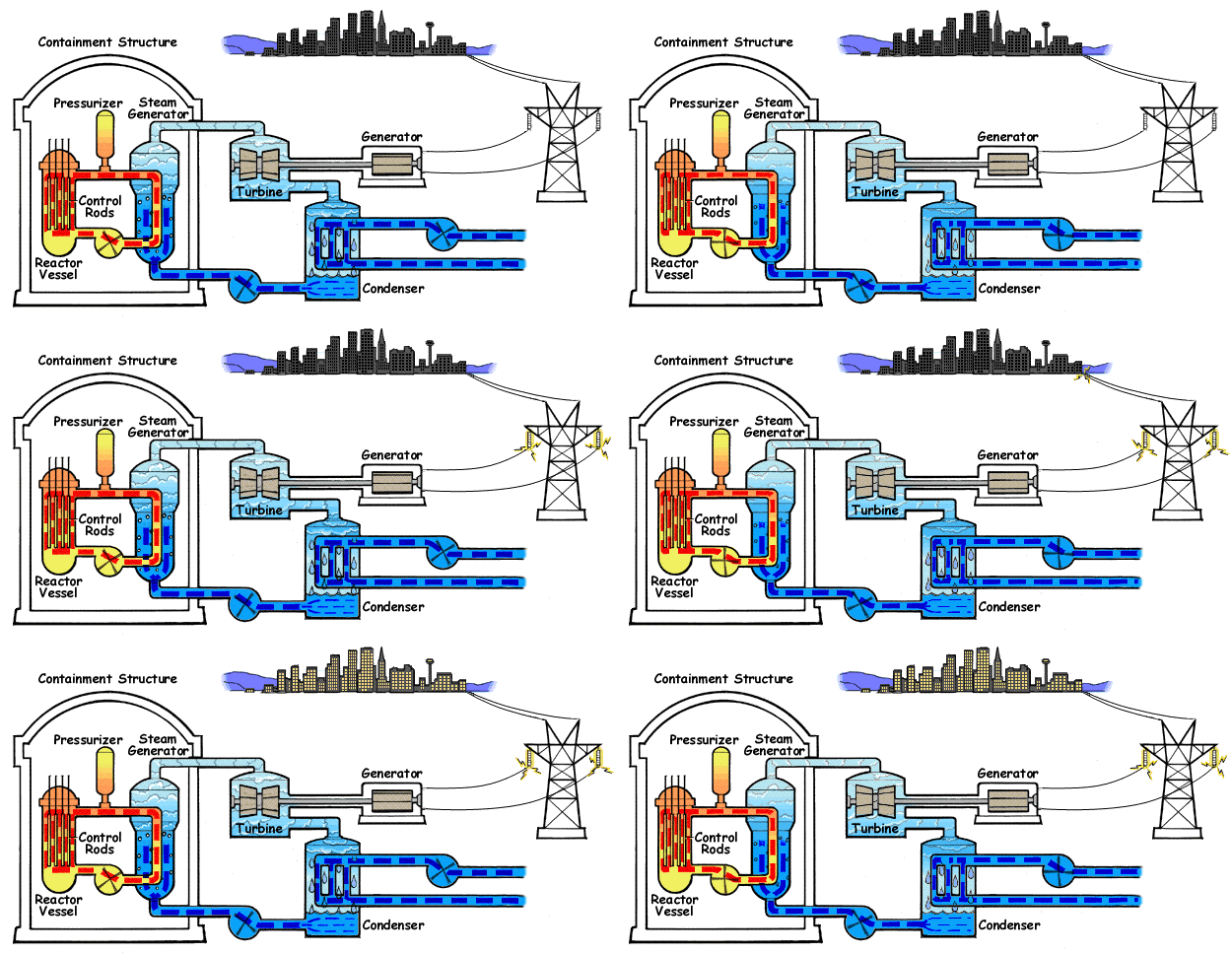
Much of the following comes from How Stuff Works, but for my sake I’m putting it mostly into my own words. We derive energy from nuclear fission in the same way that we derive energy from coal-fired power stations – by turning water into pressurised steam, which drives a turbine generator. The difference, of course, is the source of the heat – uranium rather than carbon-emitting coal. Nuclear reactors create a chain reaction which splits uranium nuclei into radioactive elements, releasing energy in the process. A thorium fuel cycle rather than a uranium one is also possible, though with limited market potential at this point.

Uranium, in the form of isotope U-235, can undergo induced fission relatively easily. However, naturally occurring uranium is over 99% U-238, so the required uranium has to be enriched so that the U-235 content, which is naturally at around 0.7%, is increased to around 3% (weapons-grade uranium enrichment requires over 90% U-235). The enriched uranium is formed into pellets, each about 2.5 cms long and less than 2cms in diameter. These are arranged into bundles of long rods which are immersed in a pressure vessel of water. This is to prevent overheating and melting. Neutron-absorbing control rods are added to or subtracted from the uranium bundle, by raising or lowering, and these control the rate of fission. Completely lowering the control rods into the bundle will shut the reaction down.

The fissioning uranium bundle turns the water into steam, and then it’s just the technology of steam driving the turbine which drives the generator. But then there’s the matter of radio-activity…

Before we get into that, though, I should mention there are different kinds of reactors, which use different systems and different cooling agents. I’ve been rather cursorily describing a Light Water Reactor, the most common type. They use normal or regular water, and there are three varieties: pressurised water reactors, as described; boiling water reactors, and supercritical water reactors. There are also heavy water reactors which use water loaded with more of the heavier hydrogen isotope called deuterium. But whatever is used as a coolant and/or a neutron moderator (a medium that moderates the speed of neutrons, enabling them to sustain a chain reaction), the issue of radio-activity needs to be dealt with.

What are the safeguards against radioactive decay? 

What I previously termed ‘induced fission’ involves firing neutrons at U-235 nuclei. The nucleus absorbs the neutron and then becomes unstable and immediately splits, releasing a great deal of heat and gamma radiation from high energy photons. Among the products of the split are fissile neutrons, which then go on to split more nuclei, a chain reaction which can be controlled with the manipulation of control rods as described above. Uranium 235 and Plutonium 239 are among the very few fissile nuclei – those that lend themselves readily to nuclear chain reactions – that we know of.

The trouble with induced fission is that the products of the reaction are vastly more radioactive than the fissioned material, U-235, and their radioactive properties are long-lasting, leading to the obvious problems of safeguard, storage and elimination.

In standard light water reactors, the pressure vessel is housed in concrete, which is in turn housed in a steel containment vessel to protect the reactor core. Refuelling and maintenance equipment is housed within this vessel. Surrounding this we have a concrete building, a secondary containment structure to prevent leakage and to protect against earthquakes or other natural (or man-made) disasters. There was no such secondary structure at Chernobyl. The nuclear industry argues that, when these safeguards are properly maintained and monitored, a nuclear power plant releases less radioactivity into the atmosphere than a coal-fired power plant.

Even if this wins some people over, there are the really big issues of mining and transportation of uranium and nuclear fuel and storage of radioactive waste. According to the USA’s Nuclear Energy Institute, 2000 metric tons of high-level radioactive waste are produced annually by the world’s nuclear reactors, which is hazardous to all life forms and can’t be easily contained. This radioactive material takes tens of thousands of years to decay. Low-level waste, which contaminates nuclear plants and equipment, can take centuries to reach safe levels.

Storage, or possible recycling, of waste is probably the major issue for the nuclear power industry’s future, in spite of all the understandable current attention given to melt-downs. The How Stuff Works website summarises the present situation:

Currently, the nuclear industry lets waste cool for years before mixing it with glass and storing it in massive cooled, concrete structures. This waste has to be maintained, monitored and guarded to prevent the materials from falling into the wrong hands. All of these services and added materials cost money — on top of the high costs required to build a plant.

In my next, and hopefully last, post on this subject (for a while at least), I’ll focus more on this storage issue, and on other developments in nuclear fuel, such as they are. I’ll be relying particularly on the MIT interdisciplinary study ‘The Future of the Nuclear Fuel Cycle’, which came out in 2011 – just when the Fukushima-Daiichi disaster hit the headlines…  

energy solutions: nuclear power, part one – the problematic past


jordan-nuclear-energy-protest2    images

Here in South Australia, our Premier (the leader of the government) has recently announced a major inquiry into the viability of nuclear power for the state, and this is raising a few eyebrows and bringing on a few fevered discussions. The Greens are saying, what need for that old and dangerous technology when we have the prefect solution in renewables? Many scientists are arguing that all options should be on the table, and that our energy future should be flexible with many different technologies in the mix – solar, wind, geothermal but also perhaps clean coal (if that’s not an oxymoron), a new-look nuclear technology, and maybe even a technology of the future, such as fusion – not to mention the harnessing of anti-matter, mentioned to me recently by an enthusiastic 12-year-old.

South Australia already has a great rep for adopting new technologies. According to wind energy advocate Simon Holmes a Court, in a talk podcasted by The Science Show recently, SA gets more than 30% of its energy from wind, and some 5% from solar. If SA was a country, it would be at the top of the table for wind power use, a fact which certainly blew me away when I heard it.

Of course, South Australia also has a lot of uranium, a fact which has presumably influenced our young Premier’s thinking on nuclear energy. I recall being part of the movement against nuclear energy in the eighties, and reading at least one book about the potential hazards, the catastrophic effects of meltdowns, the impossibility of safe storage of nuclear waste and so forth, but I’ve also been aware in recent years of new safer types of fuel rods, cooling systems and the like, without having really focused on these developments. So now’s the time to do so.

But first I’m going to focus on the nuclear power industry’s troubled past, which will help to understand the passion of those opposed to it.

No doubt there have been a number of incidents and close things associated with the industry, but the general public are mostly aware of three disturbing events, Three Mile Island (1979), Chernobyl (1986), and Fukushima (2011). I won’t go into too much detail about these, as you’ll find plenty of information about them here, here and here, and in the links attached to those sites, but here’s a very brief summary.

The Three Mile Island accident was the result of a number of system and human failures, which certainly raised questions about complex systems and the possibility/inevitability of an accident occurring, but the real controversy was about the effects, or after-effects, of the partial melt-down. It’s inevitable that anti-nuclear activists would play up the impact, and nuclear proponents would play them down, but the evidence does suggest that, for all the publicity the accident garnered, the effects on the health of workers and residents of the area were minor and, where strongly claimed, largely unsubstantiated. Anti-nuclear activists have claimed widespread death and disease among animals and livestock in the region, while the local (Pennsylvania) Department of Agriculture denied any link. Research is still ongoing, but with so much heat being generated it’s hard to make sense of any light. One thing is certain, though. When an accident does happen, the costs of a clean-up, one that will satisfy everyone, including many of the nay-sayers, is astronomical.

Two reactors were built at the Three Mile Island site in 1974, and they were state-of-the art at the time. The second reactor, TMI-2, was destroyed by the accident, but TMI-1 is still functioning, and ‘remains one of the best-performing units in USA’, according to the World Nuclear Association, which, unsurprisingly, claims that ‘there were no injuries or adverse health effects from the accident’.

A much more serious accident occurred at Chernobyl in the Ukraine, then part of the Soviet Union. It has received a level 7 classification on the International Nuclear Event Scale, the highest possible classification (Fukushima is the only other accident with this classification; Three Mile Island was classified level 5). Thirty-one people died as a direct result, and long-term radiation effects are still under investigation. The figures on cancer-related deaths are enormously varied, not necessarily due to ideological thinking, but due to different methodologies employed by different agencies in different studies. The difficulties in distinguishing the thousands of cancers resulting from the radiation and the millions of cancers suffered by people in the region over the 20 years since the accident can hardly be underestimated. Most analysts agree, however that the human death toll is well into the thousands.

The Chernobyl disaster is notorious, of course, for the response of the Soviet government. No announcement was made to the general public until two days afterwards. When it came, it was as brief as possible. Workers and emergency services personnel who attempted to extinguish the fire were exposed to very high (that’s to say fatal) levels of radiation. Others involved in the massive clean-up were also heavily exposed. The cost of the clean-up, and of building a new containment structure (the largest civil engineering task in history) amounted to some 18 billion roubles. A half a million workers were involved.

The Fukushima disaster was caused by a tsunami triggered by a 9 magnitude earthquake, and the destruction caused (a meltdown of 3 of 6 of the plant’s reactors and the consequent release of radioactive material) was complicated by the damage from the tsunami itself. It was a disaster waiting to happen, for a number of reasons, the most obvious of which was the location of the reactors in the Pacific Rim, the most active seismic area on the planet. Some of the older reactors were not designed to withstand more than magnitude 7 or 8 quakes, but the most significant design failure, as it turned out, was a gross under-estimate of the height required for the sea-wall, the fundamental protection against tsunamis. To read about the levels of complacency, the unheeded warnings, the degree of ‘regulatory capture’ (where the regulators are mostly superannuated nuclear industry heavyweights with vested interests in downplaying problems and overlooking failures) and the outright corruption within and between TEPCO (the Tokyo Electric Power Company) and government, is to be alerted to a whole new perspective on human folly. It is also to be convinced that, if the industry is to have any future whatsoever, tight regulation, sensible, scientific and long-term decision-making, and complete openness to scrutiny by the residents of the area, consumers and the general public must be paramount.

Though there’s ongoing debate about the number of fatalities and injuries caused by the nuclear power industry, that number is lower than the numbers (also hotly debated of course) caused by other major energy-generating industries. Commercial nuclear power plants were first built in the early seventies and 31 countries have taken up the technology. There are now more than 400 operational reactors worldwide. The Fukushima disaster has naturally dampened enthusiasm for the technology; Germany has decided to close all its reactors by 2020, and Italy has banned nuclear power outright. However, countries such as China, whose government is rather more shielded against public opinion, are continuing apace – building almost half of the 68 reactors under construction worldwide as of 2012-13.

It’s probably fair to say that Fukushima and Chernobyl represent two outliers in terms of operating nuclear power plants, both in terms of accident prevention and crisis management, and the upside of these disasters is the many lessons learned. I presume modern reactors are built very differently from those of the seventies, So I’m interested to find out what those differences are and what ongoing innovations, if any, will make nuclear fission a safer and more viable clean energy option for the future. That’ll mean going into some technical detail, for my education’s sake, into how this energy-generating process works. So that’ll be next up, in part 2 of this series.