Category Archives: Uncategorized

the thorium fuel future, or not…

This is a piece I started months ago, and abandoned for some reason. Better late than never…

So what about thorium as part of our clean energy future? Are there any thorium reactors operating? How do they work? How do they compare to uranium-based reactors?

Well, there appear to be a lot of plans on drawing boards, for good reason, it seems. Thorium is about three times more abundant than uranium, and is potentially a safer source of nuclear energy, which, ironically, is largely why it was overlooked early on, due to uranium’s far greater weapons potential. To quote Wikipedia,

The Thorium Energy Alliance estimates “there is enough thorium in the United States alone to power the country at its current energy level for over 1,000 years.”

When used in a liquid fluoride thorium reactor (LFTR), a type of molten salt reactor (MSR), far less nuclear waste results. And there are many other positives. An estimate by Nobel Prize-winning physicist Carlo Rubbia, for example, that a ton of thorium can produce the energy of 200 tons of uranium and three and a half million tons of coal.

And there’s more stuff about thorium’s advantages that sound just too good to be true. Wikipedia lists nine positives in bullet points. However, there are substantial start-up costs, and there are problems with ‘breeder reactors’ and proliferation, which I’ll try to understand later.

Reading the story of uranium v thorium from the late forties into the seventies, you can clearly see that the military side of the military-industrial complex, especially in the USA, won out at the expense of safe commercial and domestic energy use. But what with the recent urgency about alternatives to fossil fuels, and the concern (methinks largely unwarranted) about uranium-based nuclear, thorium is inching its way back into favour. Sabine Hossenfelder reports on its soon-to-be-arrival in Europe while castigating the German state’s pulling the plug on nuclear in general (Steve Novella of the Skeptics’ Guide is also bemused). I reckon they’re gonna change their changed mind eventually.

Anyway, the news is that the Netherlands and France, two countries that embrace nuclear power, have teamed up to bring small thorium reactors to Europe. NAAREA, a French alternative energy company, and Thorizon of the Netherlands, have combined their smarts and funds, and I’ll quote Sabine:

NAAREA is already working on small nuclear reactors, and they want to combine their technology with the thorium cores from the Dutch.

This is the concept of small, transportable nuclear reactors that I first read about in Steven Pinker’s Enlightenment Now some years ago. The fact is, though, that progress seems to be slow in this field, in spite of all the global warming concerns. NIMBYism is still a problem, as well as whole of government negativity, as in Germany. Nations that are more keen are India, which has the world’s largest thorium reserves, China, Canada and the USA.

So what about here in Australia? We have actually banned nuclear energy, both federally and in every state and territory, and there appears to be no appetite for changing the situation. This also means there’s no avenue for those interested in nuclear energy and its engineering and technical requirements to gain expertise in the field here. I suspect the only factor that will change our governmental (and popular) mindset will be the proven success of new thorium-based reactors elsewhere. Of course, Australia has the perfect climate for solar and storage, so that’s where we’re focussed, essentially. But let’s keep our minds open.

References

https://en.wikipedia.org/wiki/Thorium-based_nuclear_power

Good News: Small Nuclear Thorium Reactors are Coming to Europe (Sabine Hossenfelder video)

Steven Pinker, Enlightenment Now, 2018 (pp146-9)

nuclear fusion developments 2 – replicating the stars

ITER – in formation

Returning to nuclear fusion, I’m focussing here on the recent Royal Institute lecture mentioned in my previous fusion post (all links below). Dr Melanie Windridge starts off with the well-known point that we’re currently failing to reach projected targets for the reduction of global warming, with current national pledges taking us to 2.4 degrees C by century’s end (the target, remember, is/was 1.5°C), with energy demand rising, and energy security issues due to political instability, among other problems.

Windridge’s pitch is that, yes, we must keep on with all the possible green solutions, but fusion is the transformational solution the world needs. It potentially produces no CO2, an abundant supply of fuel, in a safe, controlled process with no long-term radioactive waste. It would also potentially produce firm, non-intermittent, base-load power – less redundancy in the grid (I probably need to do a whole post on this) – which would be more economical in the long term. Also, decarbonisation is about much more than electricity, which apparently is only about 20% of the electricity market. The other 80% is much harder to decarbonise. Windridge lists some of them – industrial heat, aviation and shipping fuels, and desalination – which I hope to explore further in another post. There’s also the opportunity, if we could develop an effective fusion energy system, with limitless clean energy, of undoing the damage already done. Current projections show that there will still be fossil fuel-based energy in the mix in 2050. This is a challenge for those interested in pursuing the fusion solution. ‘Fusion can address the fossil fuel gap’, one of Windridge’s graphs suggests. The aim, it seems to me, is that fusion will be ‘ready’ by mid-century, at which time it will be transformative or, as Windridge says ‘we need a solution with immense potential’. But prediction is tricky, especially about the future, and as a sixty-something optimist, I can only hope that I can live and be compos mentis enough to witness this transformation.

Frankly, it’s amazing that we can be considering this type of energy, a result of relatively recent understanding of our universe. As Windridge points out, the only other form of energy that is more energy-dense is matter-anti-matter annihilation (from the first few seconds after the ‘Big Bang’) – I can well imagine future researchers and engineers trying to create a Big Bang under controlled conditions in some hyper-complex cybernetic laboratory. I wouldn’t be surprised if an SF author has already written a story…

High energy density is doubtless the holy grail of future energy technology. Windridge gives a nice historical account of this – something that Gaia Vince’s Transcendence has helped me to focus on. The industrial revolution, which began in Britain, moved us from animal energy in joules per gramme to chemical energy in kilojoules (one thousand joules per gramme). This gave Britain a fantastic edge over the rest of the world, and was the vital element in creating the British Empire. Nuclear energy, which takes us to gigajoules (billions of joules) per gramme, and which, thankfully, is being pursued internationally, and hopefully collaboratively, is a breakthrough, if it works out, comparable to the invention of fire. One kg of fusion fuel can provide as much energy as 10 million kg of coal, so it would make sense to  concentrate much of our collective ingenuity on this zero-carbon form of fuel.

There are different pathways. Aneutronic fusion, as the name suggests, doesn’t rely so much on neutron energy, with its associated ionising radiation. Alpha particles or protons carry the energy. An Australian company, HB11 Energy, is using lasers to drive a low-temperature proton-boron fusion system, which is showing some promise, and deuterium-helium-3 is another combination, but currently deuterium and tritium is the easiest reaction to obtain results from. Now, considering the power of the sun, which is so energetic that, according to BBC Science Focus, ‘the Earth would become uninhabitable if its average distance from the Sun was reduced by as little as 1.5 million km – which is only about four times the Moon’s distance from Earth’, it should be pretty clear that recreating that kind of energy here on Earth’s surface is fraught with problems. The fusion ‘triple product’ for producing this energy is apparently heat, density and time. So to achieve the product in a ‘short’ time, for example, we need to tighten the other parameters – more heat and density. Safely producing temperatures much higher than those in the sun for any extended period would presumably be quite a feat of engineering. The different designs and approaches currently include tokamaks, stellarators, inertial confinement (using lasers) and magneto-inertial fusion. The inertial confinement laser model focuses lasers on a small fuel pellet, causing it to implode and produce ‘fusion conditions’.

It’s all about producing plasma of course – the so-called fourth and most energetic state of matter. Electrically-charged particles which make up over 99% of the visible universe. These charged particles spin around magnetic field lines, so allowing us to use magnetic systems to control the material. We’ve used plasma in neon lights for over a century, and its production was first demonstrated by Humphrey Davy in the early 1900s – something to explore…. Plasma is also a feature of lightning, a ‘bolt’ of which can strip electrons from the immediately surrounding air. This means that air is ionised and can be manipulated magnetically. Tokamaks and other magnetic devices operate on this principle.

Inertial confinement uses shock waves or lasers to ‘squeeze’ energy out of a pellet of fusion fuel. The point at which such energy is produced is called ignition. Think of a bicycle tyre heating up as you pump it up to a higher pressure, until the tyre explodes – sort of.

So – and I’m heavily relying on the Windridge public lecture here – fusion research really began in the fifties, generally in universities and public labs. This early work has culminated in  two major public projects, ITER (the International Thermonuclear Experimental Reactor), with its ultra-massive tokamak located in the south of France, and NIF, the National Ignition Facility, located in California. which made headlines last December for ‘the first instance of scientific breakeven controlled fusion’. This involved bombardment of a pellet ‘smaller than a peppercorn’ to produce a non-negligable energy output for a very brief period.

All of this has been at great public expense (why weren’t we told?), so in more recent times, private investment is moving things along. The last couple of years has seen quite a bit of progress, in both public and private facilities. For example, JET, in Oxfordshire, produced 59 megajoules (59,000,000 joules) of fusion energy, sustained for 5 seconds, a world record and a proof of concept for more sustainable energy production. And at NIF last year they produced ‘ignition’, the whole point of the facility, producing more fusion energy than the laser energy used to drive the process, a proof of concept for controlled fusion. And even more recently, China set a new record at their EAST tokamak (don’t you just love these territorial names), attaining steady-state ‘high performance’ plasma for about 6.5 minutes (I don’t know what high performance plasma is, but I can perhaps guess). And there is a lot of work going on in the private space too (I’ll be looking at Sabine Hossenfelder’s appraisal of the field in a future post, all in the name of education), with a really notable increase in private investment and start-ups – about half of the world’s private fusion companies today are less than 5 years old. Some $5 billion has been invested, from energy companies like Shell and Chevron, but also a variety of other organisations familiar to capitalists like me.

Why is this happening? Clearly we have a greater consensus about global warming than existed a decade ago. Also the science of fusion has reached a stage where rich people and organisations are sensing the opportunity to make even more money. Windridge also talks about ‘enabling technologies’, recent engineering and technological developments such as high-temperature superconductors, diode pumps for lasers, and various AI breakthroughs and improvements. Mastering and streamlining these developments will ultimately reduce costs, as well as expanding the range of the possible. National governments are developing regulatory frameworks and ‘fusion strategies’ – the latest coming from Japan – often involving public-private partnerships, such as the UK’s Fusion Industry Programme. The UK has also created a facility called STEP – the Spherical Tokamak for Energy Production – run by the Atomic Energy Authority, which is described by Windridge as the world’s first pilot nuclear energy plant.

So in the next post on this topic I’ll be trying to get my head around the developments mentioned above, FWIW. And it is definitely worth something. If we can get it all right.

References

Could nuclear fusion energy power the future? – with Melanie Windridge (Royal Institution video)

Gaia Vince, Transcendence, 2019

https://en.wikipedia.org/wiki/Aneutronic_fusion

https://www.sciencefocus.com/space/how-much-closer-to-the-sun-could-earths-orbit-get-and-still-be-habitable/#

https://www.psfc.mit.edu/vision/what_is_plasma

https://fusionenergyinsights.com/blog

resetting the electrical agenda

reposted from ussromantics

the all-electric la jamais contente, first car to break the 100 kph barrier, in 1899

In his book Clearing the air, Tim Smedley reminds us of the terrible errors we made in abandoning electric vehicles in the early 20th century. Smedley’s focus was on air pollution, and how the problem was exacerbated, and in fact largely caused, by emissions from car exhausts in increasingly car-dependent cities like Beijing, Delhi, Los Angeles and London. In the process he briefly mentioned the electric tram systems that were scrapped in so many cities worldwide in favour of the infernal combustion engine. It’s a story I’ve heard before of course, but it really is worth taking a deeper dive into the mess of mistakes we made back then, and the lessons we need to learn. 

A major lesson, unsurprisingly, is to be suspicious of vested interests. Today, the fossil fuel industry is still active in denying the facts about global warming and minimising the impact of air pollution on our health. Solar and wind power, and the rise of the EV industry – which, unfortunately, doesn’t exist in Australia – are still subject to ridiculous attacks by the heavily subsidised fossil fuel giants, though at least their employees don’t go around smashing wind turbines and solar panels. The website Car and Driver tells a ‘funny story’ about the very earliest days of EVs: 

… Robert Davidson of Aberdeen, built a prototype electric locomotive in 1837. A bigger, better version, demonstrated in 1841, could go 1.5 miles at 4 mph towing six tons. Then it needed new batteries. This impressive performance so alarmed railway workers (who saw it as a threat to their jobs tending steam engines) that they destroyed Davidson’s devil machine, which he’d named Galvani.

If only this achievement by Davidson, before the days of rechargeable batteries, had been greeted with more excitement and wonder. But by the time rechargeable batteries were introduced in the 1860s, steam locomotives were an established and indeed revolutionary form of transport. They began to be challenged, though, in the 1880s and 90s as battery technology, and other features such as lightweight construction materials and pneumatic tyres, started to make electric transport a more promising investment. What followed, of course, with the development of and continual improvements to the internal combustion engine in the 1870s and 80s, first using gas and then petrol – the 1870s into the 90s and beyond was a period of intense innovation for vehicular transport – was a serious and nasty battle for control of the future of private road transport. Electricity wasn’t widely available in the early twentieth century, but rich industrialists were able to create a network of filling stations, which, combined with the wider availability of cheap oil, and the mass production and marketing capabilities of industrialists like Henry Ford – who had earlier considered electric vehicles the best future option – made petrol-driven vehicles the eventual winner, in the short term. Of course, little thought was given in those days to fuel emissions. A US website describes a likely turning point: 

… it was Henry Ford’s mass-produced Model T that dealt a blow to the electric car. Introduced in 1908, the Model T made gasoline [petrol]-powered cars widely available and affordable. By 1912, the gasoline car cost only $650, while an electric roadster sold for $1,750. That same year, Charles Kettering introduced the electric starter, eliminating the need for the hand crank and giving rise to more gasoline-powered vehicle sales.

Electrically-powered vehicles quickly became ‘quaint’ and unfashionable, leading to to the trashing of electric trams worldwide. 

The high point of the internal combustion engine may not have arrived yet, as numbers continue to climb. Some appear to be addicted to the noise they make (I hear them roaring by nearly every night!). But surely their days are numbered. What shocks me, frankly, is how slow the public is to abandon them, when the fossil fuel industry is so clearly in retreat, and when EVs are becoming so ‘cool’. Of course conservative governments spend a fortune in subsidies to the fossil fuel industry –  Australia’s government  provided over $10 billion in the 2020-21 financial year, and the industry in its turn has given very generously to the government (over $1.5 million in FY2020, according to the Market Forces website).

But Australia is an outlier, with one of the worst climate policies in the WEIRD world. There will be a federal election here soon, and a change of government is very much on the cards, but the current labor opposition appears afraid to unveil a climate policy before the election. The move towards electrification of vehicles in many European countries, in China and elsewhere, will eventually have a knock-on effect here, but the immediate future doesn’t look promising. EV sales have risen markedly in the past twelve months, but from a very low base, with battery and hybrids rising to 1.95% of market share – still a paltry amount (compare Norway with 54% EVs in 2020). Interestingly, Japan is another WEIRD country that is lagging behind. China continues to be the world leader in terms of sheer numbers. 

The countries that will lead the field of course, will be those that invest in infrastructure for the transition. Our current government announced an infrastructure plan at the beginning of the year, but with little detail. There are issues, for example, about the type of charging infrastructure to fund, though fast-charging DC seems most likely.

In general, I’ve become pessimistic about Australians switching en masse to EVs over the next ten years or so – I’ve read too many ‘just around the corner’ articles with too little actual change in the past five years. But perhaps a new government with a solid, detailed plan will emerge in the near future, leading to a burst of new investment…. 

References

Tim Smedley, Clearing the air, 2019

https://www.caranddriver.com/features/g15378765/worth-the-watt-a-brief-history-of-the-electric-car-1830-to-present/

https://www.energy.gov/articles/history-electric-car

Dirty money – political donations from the fossil fuel industry

universal basic income: an introduction

The idea of a universal basic income (UBI) has been floating around for some decades, but the noises have grown louder in recent years, it seems to me, as industry and agriculture have become increasingly mechanised, at least in the developed world. This means, I’d suppose, that those with the capital to harness the technology for profitable ventures would be more able to concentrate the wealth in their hands (and in the hands of venture capitalists who back them) while the less advantaged who’ve previously relied on working for a living are left at a loss, in more ways than one.

Right now I know very little about UBI. How would it be funded, is it applied nation by nation, are there different projected plans available, has it ever been tried anywhere, what are the upsides and downsides, who’s advocating it? And so on. There are probably more questions than answers at the moment, but considering the huge gaps occurring between the rich and the poor in developed countries, and the rise of homelessness often going hand in hand with rises in GDP, this kind of apparently simplified safety net is surely at least worth a look.

First, without doing any research, I assume that ‘universal’ really means ‘national’ or ‘state’ – we’re not going to get this organised on a global scale. The second assumption is that such payments would have to come out of the taxation system, as I can’t think of any alternative. This would seem to add up to quite a bill, depending on the amount allocated on a per capita basis. There would also be offsets, such as the elimination of much welfare bureaucracy, which would perhaps throw more people out of work. There are also arguments as to whether this would amount to ‘sit down money’, or would incentivise people to be more active in business and creative fields. 

So do we have any evidence about costs and benefits? Has this approach been trialled anywhere? Well interestingly, a small-scale 3-year trial is being carried out in Fife, Scotland, very close to where I was born in Dundee. Reporting from June 2020 has it that the trial, involving only 17,000 Scots, involves a one year preparation period and an estimated minimum cost of £186m, so it will be a while before we see any results, if indeed the plan goes ahead. There are plenty of naysayers of course.

A more comprehensive test is already under way in Spain, where some 850,000 households have been supported with a ‘guaranteed minimum income’ by the leftist government since June 2020, at an estimated cost of 3 billion euros annually. This isn’t strictly a trial – the government plans to maintain the system indefinitely (meaning probably until a right-wing government takes over), but of course they’ll be monitoring it in terms of reducing poverty and boosting employment, health and other indices.

The current pandemic, unsurprisingly, has brought the UBI and it variants to the forefront once more, but it has been mooted, and tried to varying degrees, in the past. Brian Donaghy, in his booklet on basic income, gives a brief overview of these small-scale trials, in Canada, Switzerland, Finland, Namibia, Kenya and the USA. Unfortunately some of them were torpedoed by political opponents before much meaningful data could be gleaned, but one of the most interesting findings they had in common was an increased sense of good health and well-being felt by recipients. 

The fact is that, over recent decades, the term ‘welfare’ has developed distinctly negative connotations. Making the income truly ‘universal’ within a whole nation or state, rather than targeting those below a certain income level, as is the case in the Spanish trial, is really the only way to remove the idea of ‘welfare’ from these payments. 

Now, in order to understand the financial and taxation implications of a UBI, I need to undertake a steep learning journey. I may also go into some personal revelations to make it clear why these kinds of payments are of particular interest to me. 

So, having read Brian Donaghy’s booklet, A basic income for Australia, I have more questions than answers. Donaghy also makes it clear that convincing politicians of the justice of such a system will be an uphill battle, especially in dual party-style democratic countries, when both sides of the political fence are more dedicated to opposing each other than to working together, which would be essential for such a system to work. 

Despite the naysayers, the UBI and its variants refuses to die, in fact it’s finding more interest now than ever before. In spite of this, it hasn’t really been given a full trial anywhere, and the public as well as politicians are very divided on the subject.

But I need to dive in on how it might work in Australia, relying on Donaghy’s booklet.

According to the Australian Bureau of Statistic figures for 2018, average annual full-time adult earnings were fractionally under $90,000 gross – an eye-watering figure to me. Donaghy sets the UBI, for calculation’s sake, at about $24,500 annually – which is approximately that of the current aged pension, and associated supplements. So this income rises to $114,500, with the extra – the UBI (which every adult gets) – being tax free. 

But here’s where Donaghy – who’s an experienced finance journalist – leaves me behind: 

The UBI replaces the existing tax-free allowances but there are no longer individual tax allowances or rebates. 

As a perennially poor person I’ve generally paid too little in tax to worry about such things. So what is a tax-free allowance? My guess is that it includes Jobseeker, AUSTUDY, the aged pension, and such payments as carer’s and disability allowances. His remark about individual allowances covers particular payments that are distinct from these general payments. 

Donaghy then goes into tax rates, which I’ve never had to think about. What I can glean is that we have sliding tax rates, like every other country. According to the Australian Tax Office (ATO) our tax rates for the 2020-21 financial year are: no tax on annual income $18,200 or under; 19% for every dollar over $18,200 up to $45,000 (that’s 19% of $26,800 = $5092). That strikes me as a pretty reasonable tax rate for relatively low income earners. The rate from $45,000 to a whopping $120,000 is 32.5%, which also strikes me as low, though I’m pretty sure that those in this tax bracket, especially at the higher end, are howling about it. The rate goes up to 37% for earnings from $120,000 to $180,000, and then jumps to 45% for each dollar over $180,000.

Donaghy suggests that the Basic Income payment will be at the tax-free threshold, which at the current tax-free rate would be $700 fortnightly – a bit low as the tax free threshold has been lowered recently. I would expect such a payment to be around $900/fortnightly, which would mean, for simplicity’s sake, raising the threshold again. Not difficult, as governments tinker with the threshold regularly.

So, how to massage the tax system to support some kind of Basic Income? I’ll write about that next time.

References

Brian Donaghy, A basic income for Australia, 2020

on dating techniques – not what you think

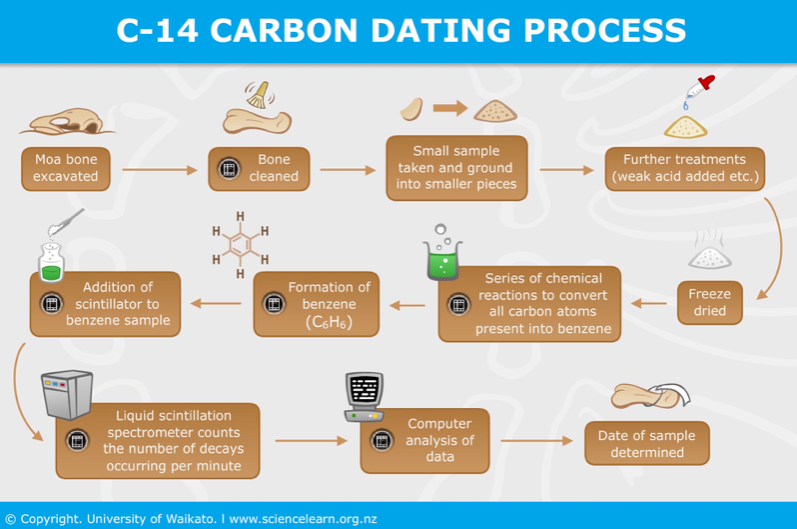
C-14 dating of a New Zealand Moa – the original pic is interactive

I’m currently reading a Christmas present book, Ancient bones: unearthing the astonishing new story of how we became human , by the German palaeontologist and palaeoclimatologist Madelaine Böhme, co-written with Rudiger Braun and Florian Breier. I’ve become very taken with it, as it’s seriously challenging a hypothesis/theory I thought was now well established, namely the ‘Out of Africa’ hypothesis. But what would I know?

I hope to write about all that elsewhere, but here, in keeping with this blog’s raison d’être, I want to focus on a couple of dating techniques for ancient fossils that have been developed in recent decades, as solutions to the problem of providing the fullest picture of the planet’s living past and its evolution. Böhme’s book gives a brief overview of some of these technologies, and I want to see if I can fully understand them.

I note that the term ‘quaternary geochronology’, which I’ve just discovered, covers dating techniques for the quaternary period – the last 2.6 million years – though Ancient Bones is dealing with proto-humans going back as far as our links with bonobos and chimps, some 7 million years ago. That’s into the late neogene period, geologically speaking.

radiocarbon

First, the most well-known, carbon-14 or radiocarbon dating. Carbon-14 is a rare, weakly radioactive isotope of carbon, first discovered in 1940, containing 8 neutrons instead of the usual 6 (carbon-13, a stable isotope, is much more common, making up 1% of all carbon). Carbon-14 is unstable and decays at a steady rate, hence its value as a tool in archaeology and geology. Böhme et al give a nice account of its use in dating:

Living plants regularly absorb C-14 out of the carbon dioxide in the air when they photosynthesise, and they incorporate it, along with C-12, into their tissues. The relationship between C-14 and C-12 in plants and in the animals that eat them therefore remains constant. After an organism dies, however, a kind of atomic clock begins to run. Because only the amount of C-14 present in the tissues at the time of death remains and no new C-14 is added, the portion of C-14 in the tissues declines at a constant rate through radioactive decay. This process is completely uniform, and it is therefore easy to translate it into time and use it to calculate the age of things.

Ancient Bones, p154

I quoted this at length, as it’s a great explanation for novices. The limitation to this dating technique, though, is the relative rapidity of C-14 decay. It has a half-life of about 5,730 years, meaning that the amount of the C-14 isotope in samples reduces by half in that time. So it is only useful for dating items less than about 50,000 years old.

Radiometric dating, using the decay rates of uranium and thorium, can date fossils and rocks back to half a million years, and other radiometric measurements (uranium-lead and potassium-argon) can take us back further still, but this depends on whether rocks contain the required elements.

magnetostratigraphy

This is a fascinating technique which examines the orientation of magnetic particles in rocks. The Earth’s magnetic field (or geomagnetic field) – which interacts with and protects us from solar wind particles – is always shifting its orientation, and every so often, over millions of years, completely reverses itself (reversal of polarity). So different strata in rock formations can be dated in terms of these magnetic reversals. These are called magnetozones. Currently, our magnetic north pole is oriented roughly with our geographic North Pole, which is described as normal polarity as opposed to reverse polarity.

However, different rock types are more or less metallic in composition, and their structure varies. The best types of sediments for this kind of dating have fine-grained metallic elements that are more likely to orient with the ambient magnetic field at deposition.

The technique is particularly useful for gathering information about rates of sediment accumulation. Changes in magnetic orientations have been plotted on a Global Metallic Polarity Time Scale (GMPTS) and this can be plotted against the depth of sediment for a particular period of orientation, known as a chron (intervals of less than 200,000 years are called sub-chrons).

There are of course other dating methods, including relative dating based on reliably dated fossil samples, and new ‘absolute dating’ techniques are being developed all the time, including, for example, thermoluminescence, electron spin resonance and electron paramagnetic resonance for dating fossil teeth. But I’ll need to learn a lot more about them.

References

Madelaine Böhme, Rudiger Braun & Florian Breier, Ancient bones: unearthing the astonishing new story of how we became human, 2020

https://www.sciencedirect.com/topics/earth-and-planetary-sciences/magnetostratigraphy

https://en.wikipedia.org/wiki/Magnetostratigraphy

https://www.spectroscopyeurope.com/component/content/article/3328-dating-fossil-teeth-by-electron-paramagnetic-resonance-how-is-that-possible

https://www.sciencedirect.com/science/article/abs/pii/1040618289900104

https://www.sciencelearn.org.nz/image_maps/37-c-14-carbon-dating-process

stand-alone solar: an off-grid solution for Australia’s remote regions (plus a bit of a rant)

(reblogged from the new ussr illustrated)

According to this article, Australia is leading the world in per capita uptake of rooftop solar, though currently South Australia is lagging behind, in spite of a lot of clean energy action from our government. The Clean Energy Regulator has recently released figures showing that 23% of Australians have installed rooftop solar in the last ten years, and this take-up is set to continue in spite of the notable lack of encouragement from the feds. South Australia is still making plenty of waves re clean energy, though, as it is continually lowering its record for minimum grid demand, through the use of solar PV. The record set a couple of days ago, interestingly on Sunday afternoon rather than in the middle of the night, was 587MW, almost 200MW less than the previous record set only a week or so before. Clearly this trend is set to continue.

It’s hard for me to get my head around what’s happening re disruptive technologies, microgrids, stand-alone solar, EVs, battery research and the like, not to mention the horribly complex economics around these developments, but the sense of excitement brought about by comprehensive change makes me ever-willing to try. Only this morning I heard a story of six farming households described as being ‘on the fringe of Western Australia’s power network’ who’ve successfully trialled stand-alone solar panels (powered by lithium-ion batteries) on their properties, after years of outages and ‘voltage spikes’*. The panels – and this is the fascinating part – were offered free by Western Power (WA’s government-owned energy utility), who were looking for a cheaper alternative to the cost of replacing ageing infrastructure. The high costs of connecting remote farms to the grid make off-grid power systems a viable alternative, which raises issues about that viability elsewhere given the decreasing costs of solar PV, which can maintain electricity during power outages, as one Ravensthorpe family, part of the trial, discovered in January this year. The region, 500 kilometres south of Perth, experienced heavy rain and flooding which caused power failures, but the solar systems were unaffected. All in all, the trial has ‘exceeded expectations’, according to this ABC report.

All this has exciting implications for the future, but there are immediate problems. Though Western Power would like to sign off on the trial as an overwhelming success, and to apply this solution to other communities in the area (3,000 potential sites have been pinpointed), current regulation prevents this, as it only allows Western Power to distribute energy, not to generate it, as its solar installations are judged as doing. Another instance of regulations not keeping up with changing circumstances and solutions. Western Power has no alternative but to extend the trial period until the legislation catches up (assuming it does). But it would surely be a mistake not to change the law asap:

“You’d be talking about a saving of about $300 million in terms of current cost of investment and cost of ongoing maintenance of distribution line against the cost of the stand-alone power system,” Mr Chalkley [Western Power CEO] said.

Just as a side issue, it’s interesting that our PM Malcolm Turnbull, whose government seems on the whole to be avoiding any mention of clean energy these days, has had solar panels on his harbourside mansion in Point Piper, Sydney, for years. He now has an upgraded 14 kW rooftop solar array and a 14kWh battery storage system installed there, and, according to a recent interview he did on radio 3AW, he doesn’t draw any electricity from the grid, in spite of using a lot of electricity for security as Prime Minister. Solar PV plus battery, I’m learning, equals a distributed solar system. The chief of AEMO (the Australian Energy Market Operator), Audrey Zibelman, recently stated that distributed rooftop solar is on its way to making up 30 to 40% of our energy generation mix, and that it could be used as a resource to replace baseload, as currently provided by coal and gas stations (I shall write about baseload power issues, for my own instruction, in the near future).

Of course Turnbull isn’t exactly spruiking the benefits of renewable energy, having struck a Faustian bargain with his conservative colleagues in order to maintain his prestigious position as PM. We can only hope for a change of government to have any hope of a national approach to the inevitable energy transition, and even then it’ll be a hard road to hoe. Meanwhile, Tony Abbott, Turnbull’s arch-conservative bête noir, continues to represent the dark side. How did this imbecilic creature ever get to be our Prime Minister? Has he ever shown any signs of scientific literacy? Again I would urge extreme vetting of all candidates for political office, here and elsewhere, based on a stringent scientific literacy test. Imagine the political shite that would be flushed down the drain with that one. Abbott, you’ll notice, always talks of climate change and renewable energy in religious terms, as a modern religion. That’s because religion is his principal obsession. He can’t talk about it in scientific terms, because he doesn’t know any. Unfortunately, these politicians are rarely challenged by journalists, and are often free to choose friendly journalists who never challenge their laughable remarks. It’s a bit of a fucked-up system.

Meanwhile the ‘green religionists’, such as the Chinese and Indian governments, and the German and Scandinavian governments, and Elon Musk and those who invest in his companies, and the researchers and scientists who continue to improve solar PV, wind turbine and battery technology, including flow batteries, supercapacitors and so much more, are improving their developments and disrupting traditional ways of providing energy, and will continue to do so, in spite of name-calling from the fringes (to whom they’re largely deaf, due to the huge level of support from their supporters). It really is an exciting time not to be a dinosaur.